Braving the Bitter Bite of Winter
As the leaves change and the air grows crisp, I can’t help but dread the impending arrival of Jack Frost. You know, that mischievous fellow who loves to sneak in and wreak havoc on our homes? Well, I’m not about to let him have his way this year – not when it comes to protecting my exterior faucets and pipes from his icy clutches.
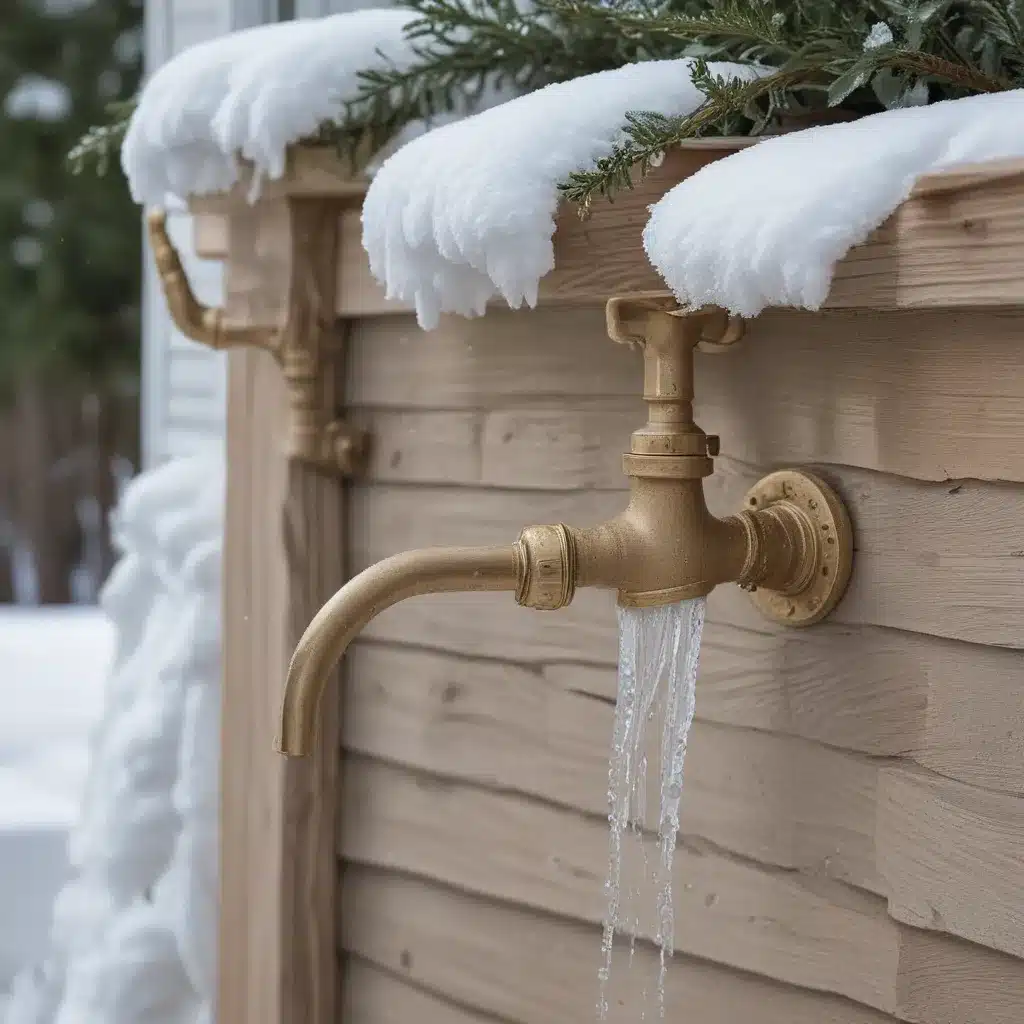
You see, I’ve had my fair share of frozen pipe catastrophes over the years. One particularly memorable incident involved a midnight dash through the snow to shut off the main water supply after hearing a loud CRACK from the backyard. By the time I got out there, icicles were already forming on the faucet and water was steadily dripping onto the frozen ground. Needless to say, it was not my idea of a pleasant winter wonderland.
After that wake-up call, I knew I needed to get serious about winterizing my home. And let me tell you, it’s made all the difference. No more middle-of-the-night emergencies or thawing sessions with the hairdryer. Just good old-fashioned preparedness and a few handy tricks up my sleeve.
So if you’re sick of dealing with the hassle and heartache of frozen pipes, then listen up! In this comprehensive guide, I’m going to share everything you need to know to protect your exterior faucets and pipes from the wintry wrath of Old Man Winter. From simple DIY insulation methods to more advanced solutions, we’ll cover it all.
Get ready to bid farewell to frozen faucets and frigid floodwaters, my friends. This is your ticket to a stress-free, ice-free season. Let’s dive in!
Understand the Threat of Freezing Temperatures
Before we get into the nitty-gritty of prevention and protection, it’s important to understand why freezing temperatures pose such a threat to our exterior plumbing in the first place. After all, knowledge is power – and in this case, it could mean the difference between a cozy, dry home and a watery disaster.
The physics behind frozen pipes is actually pretty straightforward. As the temperature drops, the water inside the pipes begins to expand. Now, you might be thinking, “But water expands when it freezes – how can that be a bad thing?” Well, the problem lies in the fact that pipes are rigid and inflexible. They can’t accommodate that expansion, which means the ice puts extreme pressure on the pipes.
Eventually, something has to give – and more often than not, it’s the pipe itself. That’s when you hear that dreaded CRACK and suddenly find yourself ankle-deep in a watery mess. Trust me, it’s not a situation you want to find yourself in. Not only is it a costly repair, but it can also cause extensive damage to your home if left unchecked.
But the threat doesn’t stop there. Even if your pipes manage to survive the freeze, the thawing process can be just as treacherous. As the ice melts, it can cause a sudden surge of water pressure that leads to leaks, cracks, and other plumbing mishaps. It’s a lose-lose situation all around.
So, the moral of the story is this: when it comes to protecting your exterior faucets and pipes, you can’t afford to take any chances. An ounce of prevention is worth a pound of cure, as they say. And trust me, you really don’t want to find out the hard way.
Insulate, Insulate, Insulate
Now that we’ve established the dire importance of protecting your exterior plumbing, let’s talk about the first (and arguably most crucial) line of defense: insulation. This is your trusty sidekick in the battle against frozen pipes, and it’s a strategy that’s as simple as it is effective.
The basic premise is straightforward – you want to create a barrier that traps warm air around the pipes and faucets, preventing the cold from seeping in and causing that dreaded freezing effect. And the good news is, there are all sorts of insulation options to choose from, ranging from the basic to the borderline-ingenious.
One of the most common and cost-effective solutions is pipe insulation sleeves. These are essentially foam tubes that you can simply slip over your exposed pipes, creating an instant barrier against the elements. They come in a variety of sizes to fit different pipe diameters, and they’re super easy to install. Just measure, cut, and wrap – it’s as easy as that.
For faucets and spigots, you can opt for insulated faucet covers or bonnets. These handy little gadgets are designed to fit snugly over the entire faucet assembly, trapping warmth and keeping the cold at bay. Some even come with built-in heating elements for added protection on those bitterly frigid nights.
But if you really want to go the extra mile, there’s always the option of more advanced insulation solutions. Things like heated pipe wraps or even full-blown heated enclosures that you can build around your exterior plumbing. These tend to be a bit more involved in terms of installation, but they offer unparalleled protection against freeze-ups.
Of course, the specific insulation method you choose will depend on factors like the size and layout of your outdoor plumbing, your budget, and your DIY prowess. But the bottom line is this: insulation is the foundation of any effective freeze-protection strategy. Neglect it at your own peril, my friends.
Shut Off and Drain Exterior Faucets
Okay, so we’ve covered the importance of insulation, but there’s another crucial step in the winterization process that you absolutely can’t afford to skip: shutting off and draining your exterior faucets.
You see, even the best insulation in the world isn’t going to do much good if there’s still water trapped in those exposed pipes and faucets. That H2O is just begging to freeze, expand, and wreak havoc on your plumbing. So, before you hunker down for the winter, you’ll want to take the time to properly shut off and drain any outdoor faucets or spigots.
The process is pretty straightforward. First, you’ll want to locate the shut-off valve for each exterior faucet – this is typically going to be somewhere inside your home, where the pipe transitions from indoor to outdoor. Once you’ve found it, turn the valve clockwise to the fully closed position.
Next, go back outside and turn the faucet on to release any remaining water. You may need to use a pair of pliers or a wrench to get it to budge if it’s been a while. Once the water has fully drained, leave the faucet in the open position. This allows any leftover moisture to evaporate, further reducing the risk of freezing.
And if you really want to be thorough, you can even go the extra mile and disconnect any hoses or attachments from the faucet. This ensures that there’s absolutely no liquid left behind to potentially freeze and cause damage.
Now, I know what you’re thinking – “But what about the faucet itself? Won’t that still be vulnerable to the cold?” And you’d be absolutely right. That’s why, in addition to shutting off the water supply, you’ll also want to insulate the faucet using one of the methods we discussed earlier. A nice cozy faucet cover or bonnet will go a long way in keeping those freeze-ups at bay.
Protect Exposed Pipes with Heat Tape
Alright, let’s say you’ve got your exterior faucets all buttoned up and your insulation game is on point. But what about those exposed pipes that are still vulnerable to the elements? Well, my friends, that’s where heat tape comes into play.
Heat tape is essentially an electrical heating element that you wrap around exposed pipes, providing an extra layer of protection against freezing temperatures. It’s kind of like having a personal space heater for your plumbing – and trust me, it’s a lifesaver when the mercury starts to drop.
The way it works is pretty straightforward. You simply unroll the heat tape and carefully wrap it around the length of the exposed pipe, securing it in place with a few strategically placed zip ties or clamps. Then, you plug it into a power source and let the toasty warmth do its thing.
Now, I know what you’re thinking – “Isn’t that going to drive up my electricity bill?” And you’d be right to be concerned. Heat tape can definitely be a power-hungry solution, especially if you’ve got a lot of exposed piping to cover. But the way I see it, the peace of mind and protection it provides is well worth the extra cost on your monthly statement.
Plus, there are some more energy-efficient options out there these days. Look for heat tape that’s thermostatically controlled, meaning it only kicks on when the temperature drops to a certain level. That way, you’re not running it 24/7 and unnecessarily driving up your energy usage.
And of course, don’t forget to pair your heat tape with a healthy dose of insulation. The two work hand-in-hand to create a cozy, climate-controlled environment for your pipes. It’s the dynamic duo of freeze protection, if you will.
So, if you’ve got any exposed exterior plumbing that’s giving you the chills, don’t hesitate to invest in some high-quality heat tape. It may cost a bit upfront, but trust me, it’s a small price to pay for the peace of mind and protection it provides.
Monitor and Maintain Throughout the Winter
Alright, we’ve covered the basics – insulation, shutting off and draining exterior faucets, and the magical world of heat tape. But you know what they say, “A home’s work is never done.” And when it comes to protecting your pipes from the winter chill, that couldn’t be more true.
You see, even with all the proper precautions in place, you can’t just set it and forget it. Nope, you’ve got to stay vigilant and keep a close eye on your outdoor plumbing throughout the entire season. Because as we all know, Old Man Winter can be a tricky fellow, and he’s always looking for a weak spot to exploit.
So, what does that “vigilance” look like in practice? Well, for starters, you’ll want to make a habit of regularly checking your insulation and heat tape. Make sure everything is still securely in place and functioning as it should. Because if that heat tape decides to quit on you in the middle of a deep freeze, you’re in for a world of trouble.
And speaking of heat tape, don’t forget to keep an eye on your power sources as well. Make sure any outlets or extension cords are in good working order and not at risk of tripping a breaker or shorting out. The last thing you want is for your pipes to suddenly lose their lifeline in the dead of winter.
But it’s not just the active protection systems you need to monitor – you’ll also want to keep a close eye on the pipes themselves. Take a quick peek outside every so often and look for any signs of trouble, like dripping faucets, icicle formations, or suspicious-looking bulges in the pipes. Catching these issues early can mean the difference between a quick fix and a full-blown disaster.
And let’s not forget about those exterior faucets we shut off and drained earlier. You’ll want to periodically check them as well, just to make sure no water has crept back in and started to freeze. It’s a good idea to crack the faucet open every now and then, just to be absolutely certain.
Ultimately, the key is to stay proactive and on top of things. Because when it comes to protecting your pipes from the icy clutches of winter, an ounce of prevention is truly worth a pound of cure. Trust me, you do not want to be the one dealing with a burst pipe in the middle of a blizzard.
So, set a recurring calendar reminder, jot it down in your planner, or tie a string around your finger – whatever it takes to make sure you’re consistently monitoring and maintaining your winterized plumbing. Your future self will thank you, I can assure you of that.
Winterize Your Entire Home for Maximum Protection
Now, I know what you’re thinking – “Okay, I get it, protecting my exterior faucets and pipes is important. But what about the rest of my home? Surely there are other steps I should be taking to prepare for the winter chill, right?”
Absolutely, my friends. When it comes to weatherproofing your abode for the cold season, your exterior plumbing is just the tip of the iceberg. There’s a whole host of other areas you’ll want to address to ensure your home is as snug as a bug in a rug.
Let’s start with your windows and doors. These are prime entry points for Old Man Winter’s icy breath, so you’ll want to make sure they’re properly sealed and insulated. Caulk any cracks or gaps, install weatherstripping around the frames, and consider investing in some sturdy, energy-efficient window coverings. Trust me, your heating bill will thank you.
Next up, take a good hard look at your attic and roof. Proper insulation up top is crucial for trapping warm air inside and keeping the cold out. And while you’re up there, do a quick inspection for any loose or damaged shingles that could let in unwanted precipitation.
Don’t forget about your basement and crawl spaces either. These often-overlooked areas can be major sources of heat loss if they’re not properly insulated and sealed. Throw some extra batting in those nooks and crannies, and make sure any cracks or openings are properly blocked off.
And let’s not forget about your HVAC system. Before the mercury really starts to plummet, be sure to have a professional come out and give your furnace a thorough checkup. Replace any worn-out parts, clean the filters, and make sure everything is running at peak efficiency. That way, when the deep freeze sets in, your heating system will be ready to rise to the occasion.
The list goes on and on, really. Weatherstripping your garage door, insulating your water heater, and even adding extra insulation to your exterior walls – it’s all fair game when it comes to winterizing your home.
Now, I know what you’re thinking – “That’s a lot of work! Do I really need to do all that?” And the short answer is, well…yes. If you want to truly protect your home from the ravages of winter, you’ve got to take a comprehensive approach. Neglecting even one area can leave you vulnerable to drafts, leaks, and other cold-weather woes.
But I promise, it’s all worth it in the end. Not only will a fully winterized home keep you warm, cozy, and energy-efficient all season long, but it’ll also save you a ton of headache (and hard-earned cash) down the line. Trust me, you don’t want to be the one dealing with frozen pipes, ice dams, or a malfunctioning furnace in the middle of a blizzard.
Hire a Professional for Peace of Mind
Alright, let’s say you’ve read through all my tips and tricks, and you’re feeling inspired to tackle the winterization of your home head-on. That’s fantastic! But I also understand that, for some of you, the prospect of doing all that work might feel a bit…overwhelming.
And you know what? I get it. Winterizing a home can be a big, daunting task, especially if you’re not particularly handy or confident in your DIY skills. That’s where hiring a professional can make all the difference.
Now, I know what you might be thinking – “But won’t that cost a fortune?” And to be honest, you’re not entirely wrong. Professional home services can certainly come with a hefty price tag. But when it comes to protecting your pipes and plumbing from the winter freeze, I firmly believe it’s money well spent.
Think about it this way – a qualified, experienced plumber or HVAC technician is going to be able to identify and address any potential problem areas much more efficiently than the average homeowner. They’ve got the expertise, the tools, and the know-how to get the job done right, the first time.
And let’s not forget about the peace of mind factor. When you hire a pro, you can rest easy knowing that your home is in good hands. No more fretting over whether you’ve properly insulated that last exposed pipe or if your heat tape is going to hold up. You can just sit back, relax, and let the experts take care of it.
Now, I’m not saying you have to go the professional route for everything. There are certainly some DIY winterization tasks that the average homeowner can tackle with a bit of elbow grease and a quick tutorial. But for the more complex or high-stakes jobs – like, say, winterizing your home’s HVAC system or dealing with a stubborn frozen pipe – it’s usually best to call in the cavalry.
At the end of the day, it all comes down to your comfort level and your budget. But trust me, the peace of mind and protection you get from hiring a pro is worth every penny. After all, your home is likely one of your biggest investments – don’t you want to make sure it’s weatherproofed and ready to brave the elements?
So, as you’re planning out your winter home prep, take a good hard look at the tasks that might be better suited for a professional. It could end up saving you a whole lot of time, stress, and potential heartache in the long run.
Conclusion: Keep Your Home Cozy and Dry All Winter Long
Well, there you have it, my friends – everything you need to know to protect your exterior faucets and pipes from the dreaded winter freeze. From insulation and heat tape to comprehensive home winterization, we’ve covered it all.
But you know, as important as all those practical tips and strategies are, there’s one more key ingredient to ensuring a cozy, dry