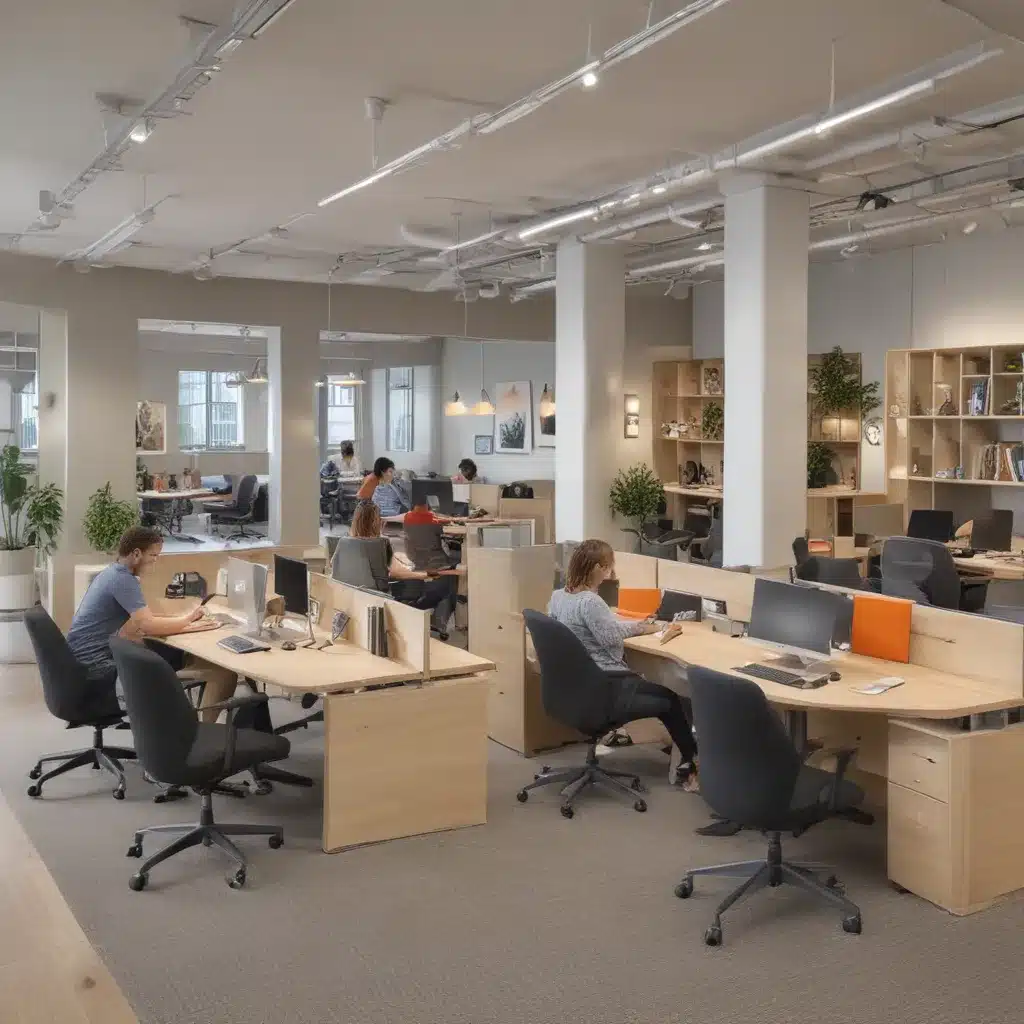
Embracing the Ebb and Flow of Business
As a business owner, I know all too well how quickly the tides can turn. One moment, you’re riding the wave of success, and the next, you’re paddling furiously to keep your head above water. It’s the nature of the game, and the sooner you accept that change is the only constant, the better off you’ll be.
That’s why, when it came time to design the new office space for ABC Home & Renovations, flexibility was at the top of my priority list. I wanted a space that could adapt and evolve alongside our business, one that wouldn’t force us to conform to its rigid structure, but rather, mold itself to our ever-changing needs.
Designing for the Future, Not the Present
As I dove into the research, I stumbled upon some fascinating insights from industry experts. The team at WeWork highlighted the benefits of a flexible workspace, noting that it can “boost collaboration and office morale” by giving employees the freedom to choose the work environment that best suits their task at hand.
But it wasn’t just about employee satisfaction – flexibility also makes good business sense. As JLL pointed out, flexible office spaces can be easily reconfigured to accommodate changing business objectives or scaled up and down to fit teams of different sizes. In other words, they’re designed to evolve with the ebb and flow of your operations.
Embracing the Unknown
Of course, designing a flexible space is about more than just throwing down a few beanbag chairs and calling it a day. As the experts at MillerKnoll noted, it’s also about fostering an “agile work environment” that promotes the idea of using different areas of the office as needed.
That means de-formalizing spaces that are typically reserved for a single purpose, like the stuffy conference room that only gets used once a month. Instead, we can transform it into an activity-based work area or a quiet zone for focused tasks.
And when it comes to technology, it’s all about making sure that power outlets and a robust WiFi network are easily accessible throughout the space. That way, our team can seamlessly transition between different work modes without the hassle of tangled cords or spotty connectivity.
Embracing the Unexpected
But the real challenge, as the MillerKnoll team pointed out, is changing the office culture. After all, we’re all creatures of habit, and it can be daunting to embrace the unknown. That’s why it’s so important to involve your team in the design process, to ensure that the space truly reflects their needs and preferences.
At ABC Home & Renovations, we did just that. We conducted surveys, held focus groups, and even invited our employees to participate in the layout planning. The result? A space that not only looks great but also feels like a natural extension of our team’s way of working.
Embracing the Future
As I look around our new office, I can’t help but feel a sense of excitement. Sure, there’s still a learning curve as we all adjust to the new way of working, but the potential is palpable. This space isn’t just a reflection of our current needs – it’s a canvas for our future growth and evolution.
And that’s the beauty of a flexible workspace. It’s not just about maximizing efficiency or cutting costs (although those are certainly benefits). It’s about embracing the unknown, the unexpected, and the ever-changing nature of business. It’s about creating a space that can adapt and evolve alongside our dreams and aspirations.
So, if you’re looking to future-proof your workspace, I encourage you to embrace flexibility. After all, as the saying goes, “the only constant in life is change.” Might as well make that change work for you.