Reaching New Heights (With Caution)
As someone who has spent countless hours on construction sites, I’ve seen my fair share of precarious situations. Ladders and roofs can be the bane of a builder’s existence, but they’re also essential tools of the trade. That’s why it’s so crucial to understand the safety standards and best practices for these high-risk areas.
The Ladder Lowdown
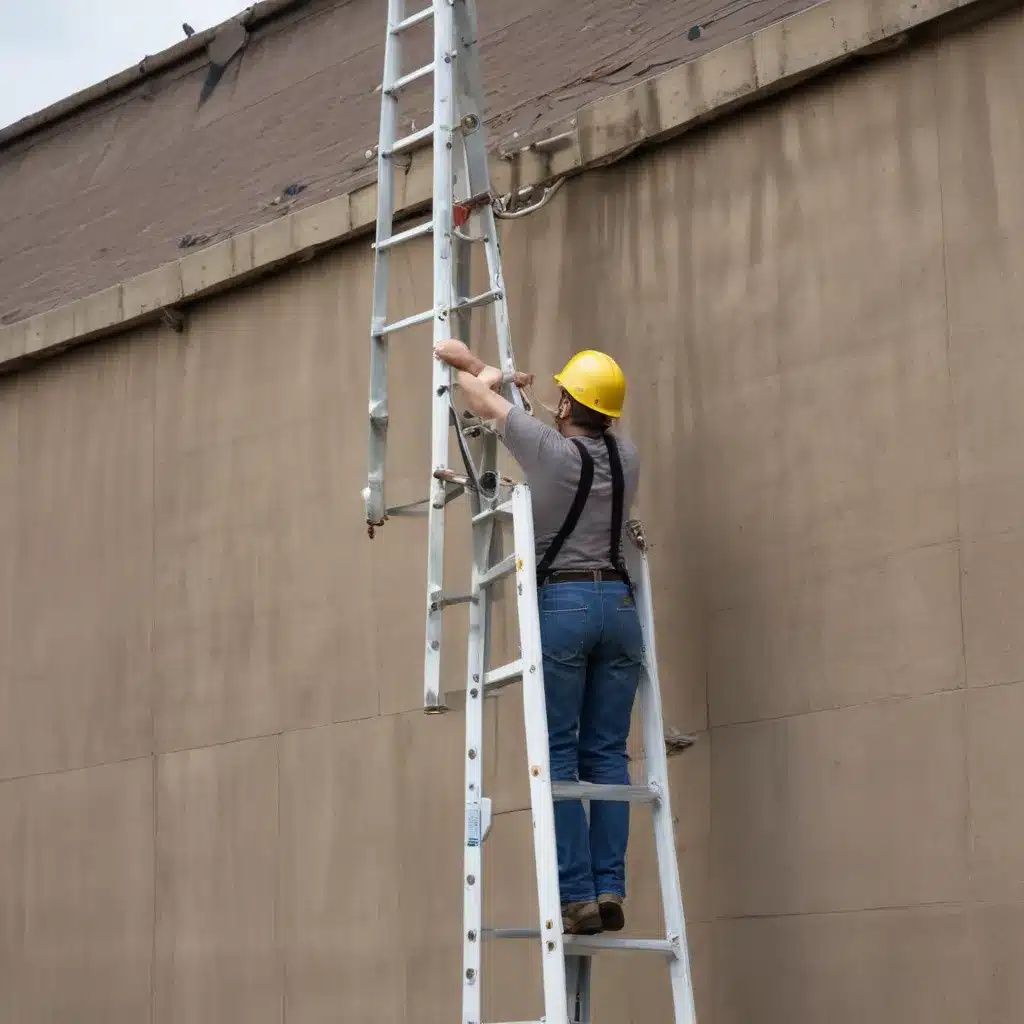
Let’s start with ladders. These unassuming structures can become death traps if not used properly. I’ll never forget the time a colleague of mine took a nasty tumble from a ladder that wasn’t secured properly. Luckily, he walked away with just a few bruises, but it could have been much worse.
According to OSHA, there are specific regulations in place to ensure ladder safety. For starters, ladders must be able to support at least four times the maximum intended load, which includes the weight of the user, any tools or materials, and the ladder itself. That means no jerry-rigging or using a ladder that’s past its prime.
Additionally, ladders should be placed on a stable, level surface and secured at the top to prevent slippage. The California Department of Industrial Relations recommends using a ladder with non-slip feet or placing it on a slip-resistant surface to further enhance stability.
But ladder safety isn’t just about the physical structure – it’s also about how you use it. OSHA stresses the importance of maintaining three points of contact (two hands and one foot, or two feet and one hand) at all times. This helps to keep your center of gravity within the ladder’s rails, reducing the risk of a dangerous fall.
Rooftop Revelations
Now, let’s talk about roof work – arguably the riskiest part of any construction job. According to Safety Pro Resources, a staggering 80 out of 108 construction-related fatalities in 2020 were due to falls, slips, and trips from roofs.
That’s a sobering statistic, but it also highlights the crucial importance of roof safety protocols. OSHA requires workers to use some form of fall protection, such as guardrails, safety nets, or personal fall arrest systems, when working at heights greater than six feet.
Guardrail systems, for example, create a physical barrier around the roof’s perimeter to prevent accidental falls. These can be either permanent or temporary, depending on the project. Safety Pro Resources notes that OSHA has specific guidelines for the height, composition, and placement of these guardrails.
Personal fall arrest (PFA) systems, on the other hand, use a body harness and lanyard to tether workers to an anchor point on the roof. These systems are designed to catch a falling worker and prevent them from hitting the ground. Of course, they need to be properly inspected and maintained to ensure they’re functioning correctly.
And let’s not forget about safety nets – those mesh barriers that are suspended just below the roof’s edge or around skylights. These act as a final line of defense, catching workers who manage to slip through the cracks of other safety measures.
Training for Triumph
But safety equipment is only half the battle. According to Safety Pro Resources, employers are also required to provide comprehensive training programs to help workers identify and mitigate fall hazards.
This training should cover everything from the proper use of personal protective equipment to techniques for maintaining three-point contact on ladders. Workers need to be able to recognize dangerous situations and know how to respond accordingly.
After all, even the best safety gear is useless if the user doesn’t know how to deploy it effectively. That’s why OSHA mandates that employers have a written certification documenting the training of each worker.
Putting it all Together
At the end of the day, safety should be the top priority for any construction company – and that starts with a deep understanding of the risks and regulations surrounding ladders and roof work.
By following ABC Home and Renovation’s robust safety protocols, we can help ensure that our workers return home to their families at the end of the day, without so much as a scratch. After all, what’s the point of building beautiful homes if we can’t keep the people who make them safe?
So, let’s raise a (firmly planted) glass to the unsung heroes of the construction industry – the workers who brave the heights and the depths to bring our visions to life. With the right training, the right equipment, and the right mindset, we can conquer any challenge that comes our way.