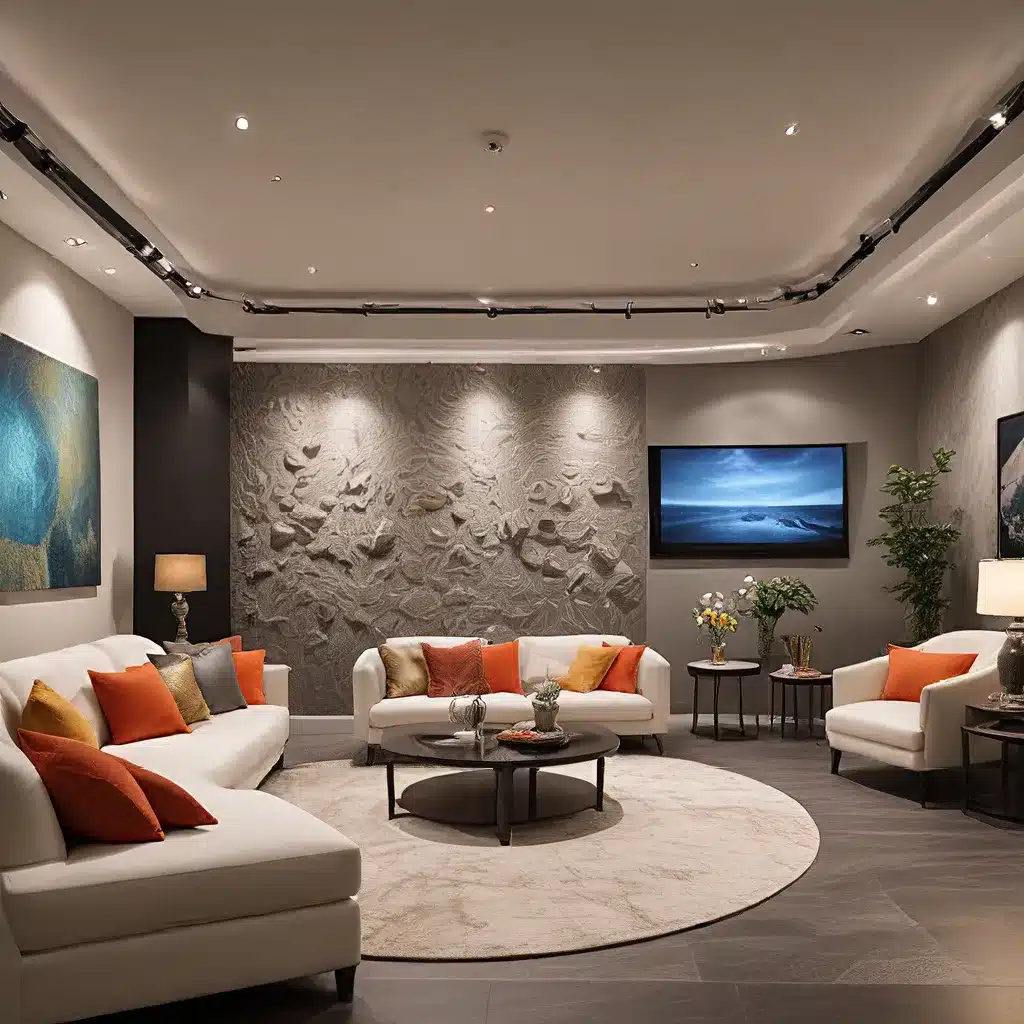
Multisensory Marvels: Engaging the Senses in Room Design
Appealing to More Than Just the Eyes
I’ll be honest – when it comes to design, I’ve always been a bit of a visual snob. Give me bold colors, sleek lines, and dramatic architectural flourishes, and I’m one happy camper. But recently, I’ve started to realize that there’s a whole sensory world out there that I’ve been missing. Smell, sound, touch – these aren’t just ancillary elements, but integral parts of crafting truly immersive, memorable spaces.
It’s a revelation that’s been a long time coming. As the saying goes, “we are visually dominant creatures.” Neuroscientific research has shown that over half of our brain is dedicated to processing visual information, compared to a mere 3% for hearing and even less for our other senses. So it’s no wonder that architects, designers, and even us everyday folks have historically been so biased towards the almighty eye.
But as I’ve learned, that singular focus comes at a cost. When we design solely for visual appeal, we risk neglecting the other senses that are crucial to how we experience and interact with a space. And in an age where we’re increasingly disconnected from our bodies and the physical world, prioritizing those multisensory experiences is more important than ever.
Waking Up the Other Senses
Take sound, for example. The ambiance of a space – whether it’s the gentle hum of a water feature, the hushed whispers in a library, or the lively clamor of a bustling café – can have a profound impact on how we perceive and feel within that environment. Architect Juhani Pallasmaa puts it beautifully: “Every building or space has its characteristic sound of intimacy or monumentality, rejection or invitation, hospitality or hostility.”
Yet all too often, sound is an afterthought in the design process, reduced to the bare minimum needed to meet acoustic standards. We’ll happily install state-of-the-art lighting and sleek furniture, but the aural experience is left to chance. As one critic lamented, “The modern architect is designing for the deaf.”
Or consider the sense of touch. The materials we encounter in a space – the smooth polish of stone, the warm grain of wood, the cool caress of metal – can evoke a visceral, emotional response. As architect Pallasmaa describes, “Natural materials – stone, brick, and wood – allow the gaze to penetrate their surfaces and they enable us to become convinced of the veracity of matter.” But increasingly, our built environments are dominated by synthetic, “unyielding” materials that lack that tactile warmth and connection.
Architect Lisa Heschong has made a whole career out of exploring the thermal aspects of architectural design, from the soothing embrace of a fireplace to the invigorating chill of a mountain stream. Yet how often do we really pause to appreciate the temperature of a space, beyond the functional need to stay comfortable?
And what about scent? Smell is one of our most powerful senses, with a unique ability to evoke memory and emotion. Yet in our efforts to eliminate any “undesirable” odors, we’ve often stripped our built environments of their olfactory character altogether. As one commentator laments, many modern spaces have become “anosmic cubes” – devoid of any distinct scent.
A Feast for the Senses
Admittedly, the idea of “gustatory architecture” – designing spaces you can literally taste – might sound a bit out there. But as Pallasmaa points out, the rich colors and textures of certain materials can absolutely elicit a sensation of taste. And in the realm of dining and hospitality design, the sensory experience is everything.
Think about the way a luxurious hotel lobby might waft with the scent of fresh flowers or the comforting aroma of baked goods. Or how the careful curation of soundscapes – from soothing background music to the ambient chatter of happy diners – can shape the ambiance of a restaurant. Even the lighting, furnishings, and overall aesthetic contribute to a synesthetic dining experience that goes far beyond just the flavors on the plate.
Designing for the Multisensory Mind
Of course, it’s not just about piling on the sensory stimuli. The key is to create a cohesive, harmonious experience that engages all of our faculties in a holistic way. As Pallasmaa eloquently states, “Architecture is the art of reconciliation between ourselves and the world, and this mediation takes place through the senses.”
In other words, it’s about striking the right balance – using each sense to complement and enhance the others, rather than competing for our attention. A space that’s visually striking but assaults our ears with harsh acoustics is just as problematic as one that’s sterile and soulless.
The good news is that there’s a growing body of research exploring the intricacies of multisensory perception and how it shapes our experiences of the built environment. Cognitive neuroscientists have found that our senses are constantly interacting, often in surprising ways. Studies have shown, for instance, that the color of ambient lighting can influence our perception of temperature, while the sounds in a space can impact our sense of safety and comfort.
So as designers, we have a real opportunity to harness these multisensory connections and create spaces that truly resonate on a deeper level. It might mean carefully curating the soundscape of a workspace to optimize focus and productivity. Or incorporating natural scents and textures to evoke a sense of wellbeing and connection. Or even playing with crossmodal correspondences – the innate associations we have between things like high-pitched sounds and small, fast-moving objects.
Beyond the Visual Realm
Of course, the dominance of the visual sense isn’t going away anytime soon. As architect David Levin laments, “I think it is appropriate to challenge the hegemony of vision – the ocular-centrism of our culture.” And he’s right – our world is still overwhelmingly designed for the eye of the beholder.
But that doesn’t mean we can’t expand our horizons and start engaging the full spectrum of human experience. By embracing a truly multisensory approach to design, we have the power to create spaces that are not just aesthetically pleasing, but deeply nourishing and compelling on a visceral level.
So the next time you’re planning a home renovation or simply rearranging your living room, I encourage you to look beyond the visual. What kind of sounds, textures, scents, and even temperatures could elevate the experience? How can you craft a holistic, harmonious environment that speaks to all of the senses?
After all, as Pallasmaa reminds us, “Every significant experience of architecture is multi-sensory.” It’s time we start designing with that in mind.
Explore our home renovation services to bring your multisensory vision to life.