The Leaky Faucet Problem
Ah, the joys of homeownership – where every dripping faucet and overflowing gutter is a testament to our never-ending battle against entropy. As the proud owner of a charming little abode in the heart of Aberdeen, I’ve had my fair share of these water-related woes. But you know what they say, when life gives you lemons… well, in my case, it’s more like when life gives you puddles, you figure out how to turn them into lemonade.
That’s why I decided to take on the challenge of installing a rainwater harvesting system. I mean, if Mother Nature is going to insist on drenching my garden and driveway on a regular basis, I might as well put that free H2O to good use, right? Plus, with water bills constantly on the rise and the growing concern over water scarcity, it just seemed like a no-brainer.
The Rainwater Harvesting Primer
Now, I’ll admit, when I first started researching rainwater harvesting, I felt a bit like I was trying to decipher ancient hieroglyphics. All these technical terms like “first-flush diverters” and “storage tanks” had me scratching my head. But I’m nothing if not determined, so I dove in headfirst, armed with a healthy dose of curiosity and a thirst for knowledge (pun intended).
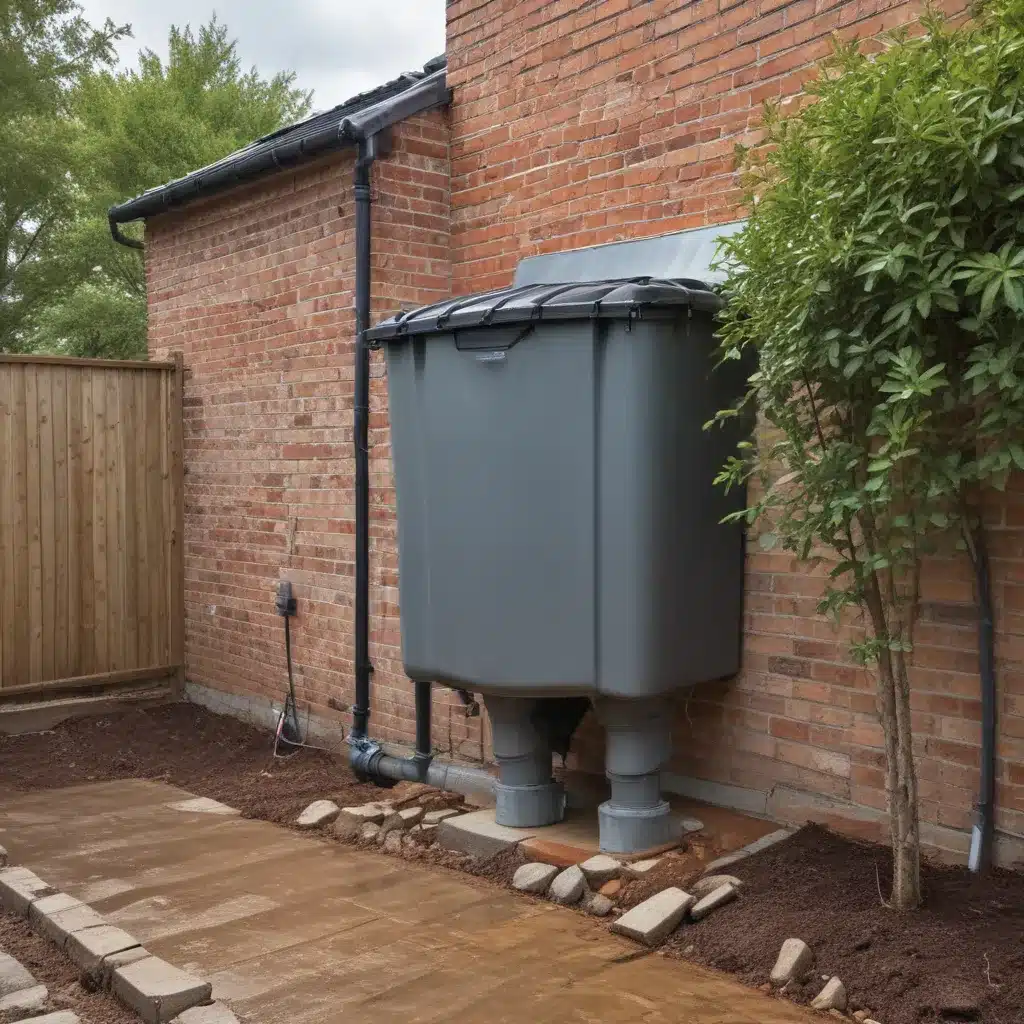
It turns out that the basic premise of a rainwater harvesting system is pretty straightforward. You’ve got your roof, which acts as a giant collection surface, channeling all that precipitation into your gutters and downspouts. From there, the water is directed into a storage tank, where it can be filtered, treated, and then used for a variety of non-potable applications, like watering the garden, washing the car, or even flushing the toilet. Pretty nifty, right?
But of course, as with any home improvement project, the devil is in the details. There are a whole host of factors to consider, from the size of your roof and the local rainfall patterns, to the local regulations and building codes. It’s enough to make your head spin faster than a centrifugal water pump.
Navigating the Planning and Installation Process
One of the first steps in the rainwater harvesting journey is determining the size of the system you’ll need. This involves calculating the runoff potential of your roof, which is basically just a fancy way of saying “how much water can it collect?” To do this, you’ll need to know the square footage of your roof and the average annual rainfall in your area.
Now, I’ll admit, when I first started crunching the numbers, it felt a bit like I was back in high school math class. But then I remembered a trick I learned from my Uncle Angus, the self-proclaimed “king of the spreadsheet.” He always said that the key to mastering any complex problem is to break it down into smaller, more manageable chunks. And that’s exactly what I did.
I started by measuring the dimensions of my roof, then cross-referenced that with the rainfall data for Aberdeen. After a few calculations and a couple of “aha!” moments, I had a pretty good estimate of how much water my system would be able to harvest. Turns out, my little 1,500-square-foot roof could potentially collect over 30,000 gallons of rainwater per year! That’s enough to fill a decent-sized swimming pool.
Of course, actually storing and using all that water is a whole other challenge. That’s where the storage tank comes into play. These come in a variety of shapes, sizes, and materials, from sleek, above-ground plastic models to rugged, buried concrete behemoths. I ultimately settled on a 2,500-gallon polyethylene tank, which I had installed just a few feet from my home’s foundation.
Now, I know what you’re thinking – 2,500 gallons sounds like a lot, but what if I run out of storage space? Well, that’s where the concept of a “first-flush diverter” comes in handy. This nifty little device ensures that the first bit of rainwater, which can be chock-full of leaves, dirt, and other gunk, gets diverted away from the storage tank and into the main drainage system. That way, only the clean, pure rainwater makes it into your tank.
Filtration, Treatment, and Usage
Of course, once the water is safely stored, you’ll want to make sure it’s clean and ready for use. That’s where the filtration and treatment systems come into play. These can range from simple mesh screens to more sophisticated UV disinfection units, depending on your needs and budget.
In my case, I opted for a multi-stage filtration setup, with a coarse mesh filter at the tank inlet, followed by a finer cartridge filter and a UV light treatment system. This ensures that any lingering sediment, bacteria, or other nasties are removed before the water is pumped into my home’s plumbing system.
And let me tell you, the difference in water quality is night and day. Gone are the days of murky, chlorine-y tap water. Instead, I’ve got crystal-clear, fresh-tasting rainwater that’s perfect for all sorts of non-potable uses. I’ve even started using it to top up my koi pond, much to the delight of my finned friends.
The Benefits of Rainwater Harvesting
But the real beauty of a rainwater harvesting system isn’t just the water itself – it’s the long-term benefits it can provide. For starters, there’s the cost savings. By reducing my reliance on the municipal water supply, I’ve been able to shave a significant chunk off my monthly water bill. And let’s not forget the environmental impact – every gallon of rainwater I collect is one less gallon that has to be treated and pumped through the city’s aging infrastructure.
And speaking of the environment, did I mention the positive impact rainwater harvesting can have on your garden? I’ve noticed a dramatic improvement in the health and vitality of my plants since I started using the harvested water. It’s chock-full of natural minerals and nutrients that help them thrive, and it’s far gentler on delicate root systems than the heavily chlorinated stuff that comes from the tap.
But perhaps the most rewarding aspect of my rainwater harvesting journey has been the sense of empowerment and self-sufficiency it’s instilled in me. It’s like I’ve tapped into a secret, sustainable superpower that allows me to take control of my water usage and do my part to conserve this precious natural resource. And let me tell you, there’s nothing quite like the feeling of watching the rain pour down and knowing that every drop is being put to good use.
Overcoming Challenges and Embracing the Adventure
Of course, no home improvement project is without its fair share of challenges. Installing the rainwater harvesting system was no exception. From navigating the local building codes to troubleshooting the occasional plumbing hiccup, there were definitely a few moments where I felt like throwing in the towel and just going back to the old, trusty municipal water supply.
But you know what they say – nothing worth having comes easy. And with a little perseverance, a healthy dose of problem-solving skills, and the occasional assistance from the team at ABC Home, I was able to overcome each and every obstacle that came my way.
In fact, I’d say the challenges I faced actually made the whole experience even more rewarding. It was like a real-life puzzle, with each new issue presenting an opportunity to learn and grow. And let me tell you, there’s nothing quite like the satisfaction of stepping back and admiring your handiwork, knowing that you’ve not only installed a functional rainwater harvesting system, but also gained a whole new set of DIY skills in the process.
Spreading the Rainwater Harvesting Gospel
As I look back on my rainwater harvesting journey, I can’t help but feel a deep sense of pride and accomplishment. But more than that, I’m filled with a desire to share my story and inspire others to follow in my footsteps.
Because let’s be real, in a world where water scarcity is a growing concern and our utility bills are constantly on the rise, the benefits of rainwater harvesting are just too good to ignore. And the best part? It’s not just for the eco-warriors and sustainability enthusiasts among us. Nope, this is a solution that can work for pretty much anyone, from the urban apartment dweller to the sprawling country estate owner.
So if you’re reading this and you’re tired of feeling like a slave to your water meter, or if you’re just looking for a way to add a little more green to your thumb, I encourage you to give rainwater harvesting a serious thought. It might just be the solution you’ve been searching for all along.
And who knows, maybe I’ll even see you around town, proudly showing off your own rainwater harvesting system. After all, the more of us who join the movement, the better off we’ll all be. So let’s do it – let’s let it rain, and let’s make the most of every single drop.