
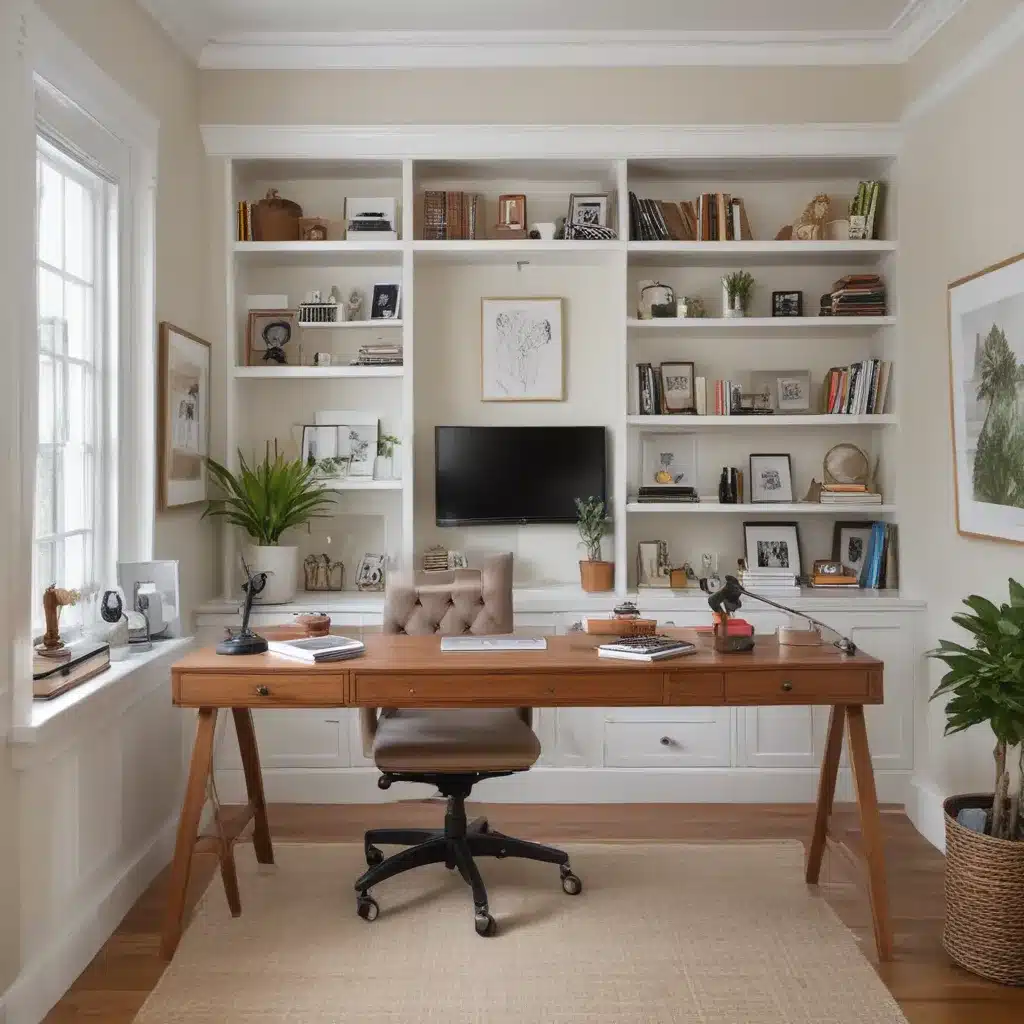
The Importance of a Dedicated Workspace
As a homeowner in Aberdeen, UK, I understand the challenges of carving out a productive workspace within the confines of our beloved abodes. Gone are the days of the traditional nine-to-five grind, confined to a corporate cubicle. The rise of remote work and the gig economy has ushered in a new era, one where our homes have become the epicenter of our professional lives. But let’s be honest, trying to balance the demands of work and the comforts of home can be a delicate dance, fraught with distractions and disruptions.
That’s why I’m here to share my insights on designing a home office that not only enhances your productivity but also seamlessly integrates into the fabric of your living space. After all, I’ve been there, struggling to find my flow amidst the allure of the fridge and the siren call of the TV. But through trial and error, I’ve discovered the secret to creating a home office that truly works for me – and I’m confident it can work for you too.
Defining Your Task Zones
The first step in crafting the perfect home office is to understand the various tasks and activities that comprise your workday. Think of it like a choose-your-own-adventure novel, where each chapter represents a different aspect of your professional life. Are you a numbers wizard, constantly crunching data and generating reports? Or perhaps you’re a wordsmith, spending hours crafting the perfect pitch or proposal? Maybe you’re a visual creative, bringing your ideas to life through the power of design.
Regardless of your role, the key is to identify the distinct “task zones” that make up your work routine. This could include a dedicated space for research and analysis, a zone for collaborative brainstorming, and even a cozy nook for focused, solo work. By compartmentalizing your workspace in this way, you’ll not only maximize efficiency but also cultivate a sense of intentionality and flow.
But don’t just take my word for it. Let’s dive into the real-world example of Sarah, a marketing consultant who recently transformed her spare bedroom into a thriving home office. “I used to work from the kitchen table, surrounded by the constant hum of household activities,” Sarah confesses. “It was chaos, and I found myself constantly switching between tasks, never truly able to immerse myself in my work.”
That all changed when Sarah took the plunge and created her own task-based zones. “I started by designating a specific area for research and brainstorming, complete with a large whiteboard and comfy armchair. Then, I set up a separate desk for data analysis and report writing, complete with dual monitors and a powerful laptop.”
The result? Sarah reports a significant boost in her productivity and a newfound sense of focus. “Now, when I sit down at my ‘research’ zone, my mind instantly shifts into that analytical mode. And when I move to the ‘writing’ desk, I can truly immerse myself in crafting the perfect copy without the temptation to check social media or tidy the kitchen.”
Optimizing Ergonomics and Lighting
Of course, designating your task zones is only half the battle. The next crucial step is ensuring that your home office is designed with both comfort and functionality in mind. After all, what good is a meticulously organized workspace if it leaves you with a sore back and tired eyes?
This is where the principles of ergonomics come into play. I’m not just talking about the obligatory desk chair with lumbar support – although that’s certainly a must-have. No, I’m talking about the holistic integration of your workstation, from the height of your monitor to the placement of your keyboard and mouse.
Take, for instance, the case of John, a freelance software developer who spent countless hours hunched over his laptop, battling wrist pain and eye strain. “I thought I was saving space by using a compact laptop, but it was wreaking havoc on my posture and causing all sorts of discomfort,” John laments.
That is, until he discovered the magic of ergonomic adjustability. “I invested in a height-adjustable desk and a monitor arm that allowed me to position the screen at the perfect eye level. I also swapped out my old mouse for a vertical model that aligns my wrist in a more natural position.”
The transformation was nothing short of miraculous. “The aches and pains disappeared, and I found myself able to work for longer stretches without fatigue. It was like a whole new world had opened up to me.”
But ergonomics goes beyond just the workstation itself. Proper lighting is also a crucial element in creating a comfortable and productive home office environment. “I used to rely on a single overhead light, which created harsh shadows and caused my eyes to strain,” John confesses. “Now, I have a combination of task lighting and ambient lighting that creates a warm, inviting atmosphere without any glare or strain.”
Striking a Balance with Aesthetics
Now, I know what you’re thinking – “Alright, I’ve got the functionality down, but what about the style factor?” Fear not, my friends, for a well-designed home office can be both highly functional and visually appealing.
After all, our work environment has a profound impact on our mood and mindset. Just think about the difference between a drab, cluttered cubicle and a bright, airy workspace filled with personal touches. The former can feel like a prison cell, while the latter can inspire creativity and motivation.
Take the case of Emily, a graphic designer who recently overhauled her home office. “I used to work in this dingy, windowless room that felt more like a dungeon than a creative hub,” she laments. “It was soul-crushing, and I found myself dreading the workday before it even began.”
But Emily wasn’t about to let her workspace dictate her productivity and well-being. She embarked on a mission to transform her home office into a sanctuary of sorts – a place where she could thrive and truly enjoy the process of work.
“I started by painting the walls a soothing shade of blue, which instantly made the space feel more calming and inviting,” Emily explains. “Then, I brought in some potted plants to add a touch of natural beauty and fresh oxygen to the mix.”
But the true game-changer, according to Emily, was the incorporation of personal touches. “I hung up some of my favorite artwork and even added a cozy reading nook with a plush armchair. It’s amazing how these small details can transform a space from a clinical workspace to a truly inspiring, personalized haven.”
The results speak for themselves. “I find myself looking forward to my workdays now,” Emily beams. “I actually enjoy the process of creating, and I believe it’s all thanks to the intentional design of my home office.”
Embracing Flexibility and Adaptability
Now, let’s talk about the elephant in the room – or rather, the elephant that’s constantly evolving and growing. I’m talking, of course, about the nature of our work itself. In this rapidly changing landscape, where the boundaries between work and life are constantly in flux, the concept of a static, rigid home office simply won’t cut it.
Enter the idea of flexibility and adaptability – the cornerstones of a truly future-proof workspace. Think about it – the tasks and tools that define your workday today may be vastly different from what you’ll be tackling a year from now. That’s why it’s crucial to design a home office that can evolve and adapt alongside your ever-changing needs.
Take, for instance, the case of Sarah, our marketing consultant friend. As her business grew and she took on more collaborative projects, she found herself in need of a more versatile workspace. “I realized that my dedicated ‘research’ and ‘writing’ zones were great for individual work, but they weren’t really conducive to group brainstorming sessions or client meetings,” she explains.
So, Sarah got creative. She incorporated modular furniture pieces that could be easily rearranged to accommodate different configurations. “Now, I can quickly transform my home office into a mini-conference room when I need to host a virtual team meeting. And when it’s time to hunker down and focus on a big project, I can reconfigure the space to suit my individual needs.”
But it’s not just about the physical layout – it’s also about the technological infrastructure that powers your home office. “I made sure to invest in a high-quality webcam, a reliable WiFi setup, and even a portable whiteboard that I can use for remote collaboration,” Sarah shares. “That way, I’m always ready to adapt to the changing demands of my work, whether it’s a last-minute client call or a spontaneous brainstorming session with my team.”
Conclusion: Crafting a Home Office that Works for You
As I reflect on my journey of designing the perfect home office, I’m struck by the realization that there’s no one-size-fits-all solution. What works for me might not work for you, and that’s perfectly okay. The key is to approach the process with an open mind, a willingness to experiment, and a deep understanding of your own unique needs and preferences.
So, my fellow Aberdeen-based homeowners, I encourage you to embrace the challenge of creating a home office that truly works for you. Dive into the world of task zones, ergonomics, and aesthetic design. Explore the power of flexibility and adaptability. And most importantly, don’t be afraid to let your personality shine through.
After all, your home office is a reflection of your professional identity – a space where you’ll spend countless hours bringing your ideas to life. So why not make it a place that you genuinely enjoy? A space that inspires you, energizes you, and helps you thrive in this new era of remote and hybrid work.
If you’re ready to take the plunge and transform your home into a productivity powerhouse, be sure to check out abc-home.co.uk for all your building and renovation needs. From custom cabinetry to carefully curated lighting solutions, our team of experts is here to help you create the home office of your dreams.
So, what are you waiting for? Let’s get started on the journey of designing the ultimate home office, one task zone at a time.


