
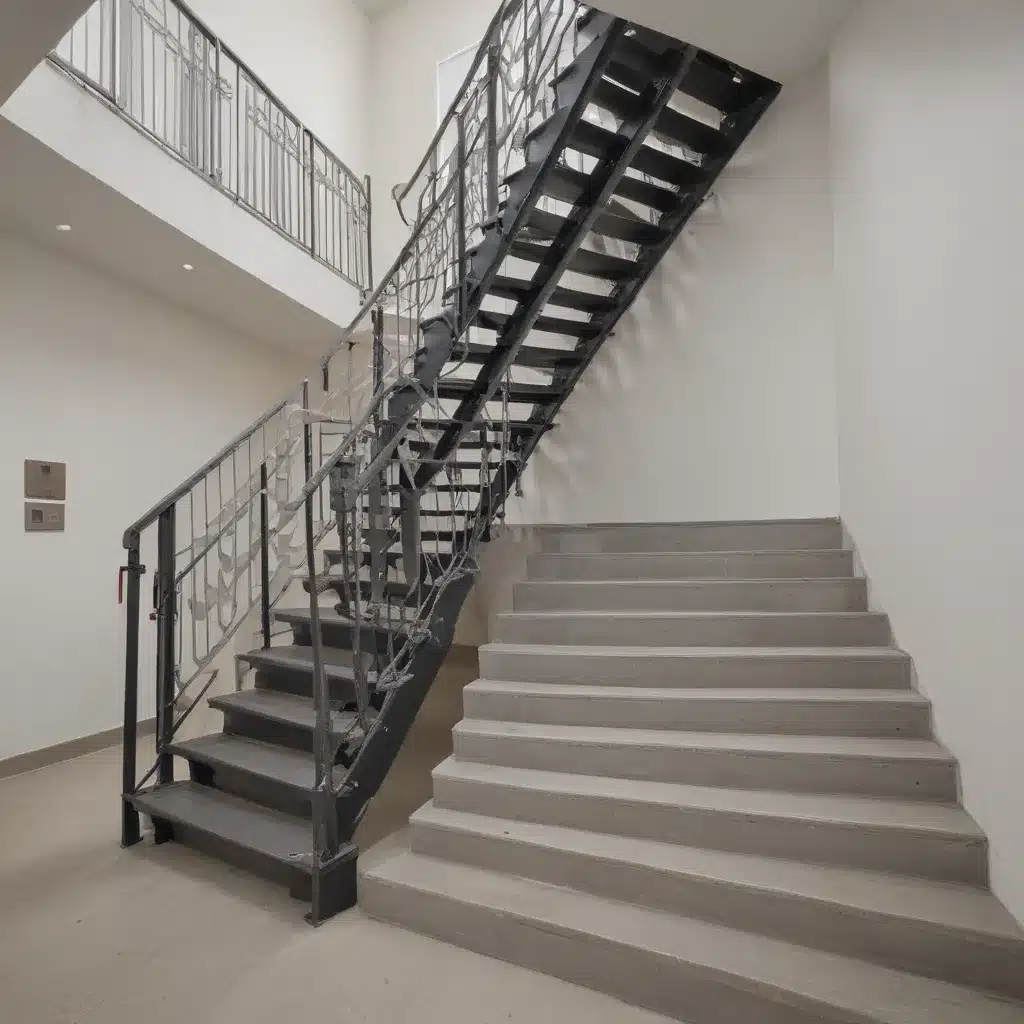
Navigating the Intricate World of Stairway Safety
As a homeowner in Aberdeen, UK, I know all too well the importance of ensuring our living spaces are not only visually appealing but also safe and compliant with all necessary regulations. And when it comes to stairway design, fire safety is of the utmost concern.
You see, I’ve had my fair share of run-ins with local authorities over the years. Just last month, I received a strongly worded letter from the fire department, sternly reminding me that my staircase was not up to code. Apparently, the treads were a smidge too narrow, and the handrail wasn’t quite up to snuff. Needless to say, I found myself in a bit of a pickle.
Determined to get my home back in the good graces of the fire marshal, I dove headfirst into the world of stairway safety standards. And let me tell you, it’s a rabbit hole deeper than the Grand Canyon. But fear not, dear reader, for I’ve emerged from the other side with a wealth of knowledge that I’m excited to share with you.
Decoding the Intricacies of Stairway Fire Safety
Before we dive into the nitty-gritty, let’s start with the basics. What exactly are the fire safety standards when it comes to stairway design? Well, my friends, it’s a veritable labyrinth of regulations, all designed to keep our homes and families safe.
For starters, the width of your staircase is of the utmost importance. According to the Building Regulations in the UK, the minimum width for a domestic staircase is 900mm. Anything less, and you’re just asking for trouble. Trust me, you don’t want to be the one who has to explain to the fire chief why your stairwell is narrower than a supermodel’s waistline.
But it’s not just the width that matters – the treads and risers must also be up to snuff. The ideal tread depth should be between 250mm and 300mm, while the riser height should be between 150mm and 170mm. Anything outside of these parameters, and you might as well wave a giant “DANGER” sign at the top of your stairs.
And let’s not forget about the handrails. These essential safety features need to be positioned at a height between 900mm and 1100mm, with a grip that’s easy for both children and adults to grasp. And if you’ve got little ones in the house, make sure those handrails extend at least 300mm beyond the top and bottom of the stairs. After all, you don’t want any tiny tot taking a tumble on their way to the kitchen for a midnight snack.
Balancing Aesthetics and Safety
Now, I know what you’re thinking – “But wait, I want my staircase to look good, not just be safe!” And believe me, I get it. We all want our homes to be the envy of the neighborhood, with staircases that are both functional and visually stunning.
But here’s the thing – you don’t have to sacrifice style for safety. In fact, with a little bit of creativity and a lot of attention to detail, you can strike the perfect balance between the two.
Take, for example, the case of my good friend, Sarah. She’s a real estate agent who recently renovated her townhouse in the heart of Aberdeen. When she first bought the place, the staircase was a total eyesore – all dark wood and outdated railing. But Sarah was determined to turn it into a true showstopper.
So, she enlisted the help of a local building and renovation company, ABC Home, and together they worked their magic. They widened the staircase to meet the fire safety standards, but they also added a gorgeous, modern glass railing that instantly elevated the space. And the treads? Well, they opted for a sleek, minimalist design that not only looked great but also provided the perfect amount of grip.
The end result? A staircase that’s not only safe and up to code but also the envy of the entire neighborhood. Every time Sarah’s friends come over, they can’t help but stop and admire her handiwork. And you know what they say – happy homeowner, happy life!
Navigating the Permitting Process
Of course, the road to a fire-safe staircase isn’t always a smooth one. In fact, it can sometimes feel like you’re navigating a veritable minefield of permits and inspections.
But fear not, my friends – with a little bit of know-how and a healthy dose of patience, you can conquer the permitting process like a pro.
The first step, of course, is to familiarize yourself with the local building regulations. In Aberdeen, you’ll need to get the approval of the Building Standards team before you can even think about starting your renovation. And trust me, these folks are not to be trifled with.
But don’t worry, the team at ABC Home has got your back. They’ve been working with the local authorities for years, and they know all the ins and outs of the permitting process. They can help you navigate the paperwork, ensure your design is up to code, and even schedule the necessary inspections.
And let me tell you, those inspections are no joke. The fire marshal will be combing through every last detail of your staircase, from the width of the treads to the height of the handrails. But with the help of the experts at ABC Home, you’ll be able to sail through the process with flying colors.
Elevating Your Staircase: Real-Life Inspiration
Now, I know what you’re thinking – “All this talk of regulations and permits is making my head spin. Is there any hope for a truly stunning staircase?”
Well, my friends, let me share with you a few real-life examples that just might inspire you to reach for the stars.
Take, for instance, the case of my neighbor, Liam. He recently undertook a massive renovation project on his Victorian-era townhouse, and let me tell you, the results are nothing short of breathtaking. He worked closely with the team at ABC Home to design a staircase that not only met all the fire safety standards but also served as the centerpiece of his home.
They opted for a grand, sweeping design with elegant, curved handrails that seemed to defy gravity. And the treads? Well, they chose a rich, dark wood that perfectly complemented the rest of the home’s decor. The end result was a staircase that was not only functional but also a true work of art.
And then there’s the case of my friend, Sarah, whom I mentioned earlier. Her townhouse renovation was a true masterpiece, and the staircase was the crown jewel. By working closely with the team at ABC Home, she was able to create a space that was both visually stunning and completely up to code.
The key, she told me, was to never compromise on safety. “Sure, I wanted my staircase to look amazing,” she said, “but I also wanted to make sure my family was safe. And thanks to the experts at ABC Home, I was able to do both.”
Conclusion: Embracing the Challenge, Elevating Your Space
So, there you have it, folks – the ins and outs of meeting fire safety standards with your stairway design. It may seem like a daunting task, but with the right team by your side, it can be a truly rewarding and fulfilling experience.
Just remember, safety should always be your top priority. But that doesn’t mean you have to sacrifice style. With a little bit of creativity and a whole lot of attention to detail, you can create a staircase that not only meets all the necessary regulations but also serves as the crown jewel of your home.
So, what are you waiting for? Grab your hard hat, round up your trusted team of experts, and let’s get to work on creating the staircase of your dreams. Who knows, maybe your home will be the envy of the entire neighborhood. After all, isn’t that the ultimate goal?


