Kitchen electrical load calculations help you understand why a quote may include circuit changes, new protection or extra testing. They are not a substitute for design to current UK wiring regulations.
The useful homeowner step is to list the appliances and how the kitchen will be used, then hand that information to the electrician before walls, cabinets and floors are closed up.
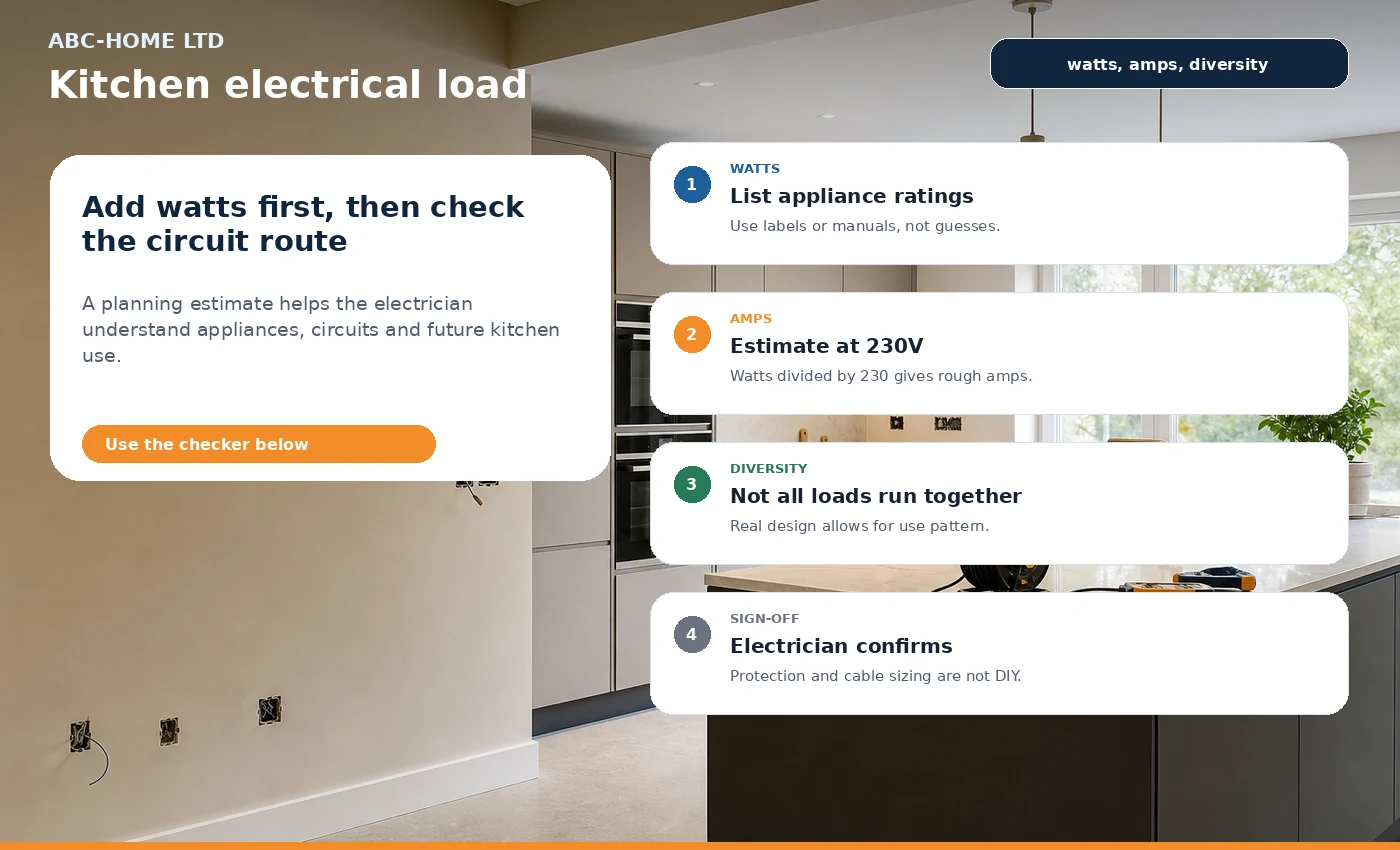
Kitchen load planning table
| Item | Typical planning check | Why it matters |
|---|---|---|
| Kettle / toaster / small appliances | Often high short bursts | Several high-load countertop items can stress an old or overloaded arrangement. |
| Oven / hob | Check product rating and supply requirement | Some appliances need a dedicated supply or different circuit planning. |
| Dishwasher / washing machine | Check wattage and location | Wet appliances need socket position, access and isolation thinking. |
| Extractor / lighting | Usually smaller loads | Still needs safe switching, route and protection. |
| Existing circuits | Identify ring final, radial and lighting routes | The existing consumer unit and circuit condition may limit the simple answer. |
Kitchen load estimate checker
Enter rough wattage for the main kitchen appliances. The result is a discussion guide, not a circuit design.
Where the number comes from
Most appliance labels give watts. Divide watts by 230 to estimate current in amps.
Why raw totals mislead
A raw total assumes everything runs at full power together. Electricians apply proper design judgement.
What to prepare
List appliance model ratings, island plans, extractor route and any future kitchen changes.
When it becomes electrical work
New circuits, altered routes and consumer-unit work need a qualified electrician.
Sources and checks used
- Electrical Safety First: kitchen safety guidance for appliances and sockets
- IET Wiring Regulations: reference point for BS 7671 wiring-regulation work
- Scottish Government Building Standards: Scotland compliance context where building work is involved
- SELECT: Scottish electrical trade body and contractor route
FAQ
Can I calculate my own kitchen circuit size?
You can estimate appliance load, but circuit size and protection must be designed by a qualified electrician.
Is watts divided by 230 enough?
It gives a rough current estimate only. Diversity, circuit type, cable route and protection change the final design.
Do all kitchen appliances need their own circuit?
No. Some do, some do not. The appliance rating, manufacturer instructions and existing installation decide the route.
Planning work in Aberdeen? ABC Home can coordinate the practical kitchen, renovation and electrical route through electrical services and kitchen fitting where the project overlaps.