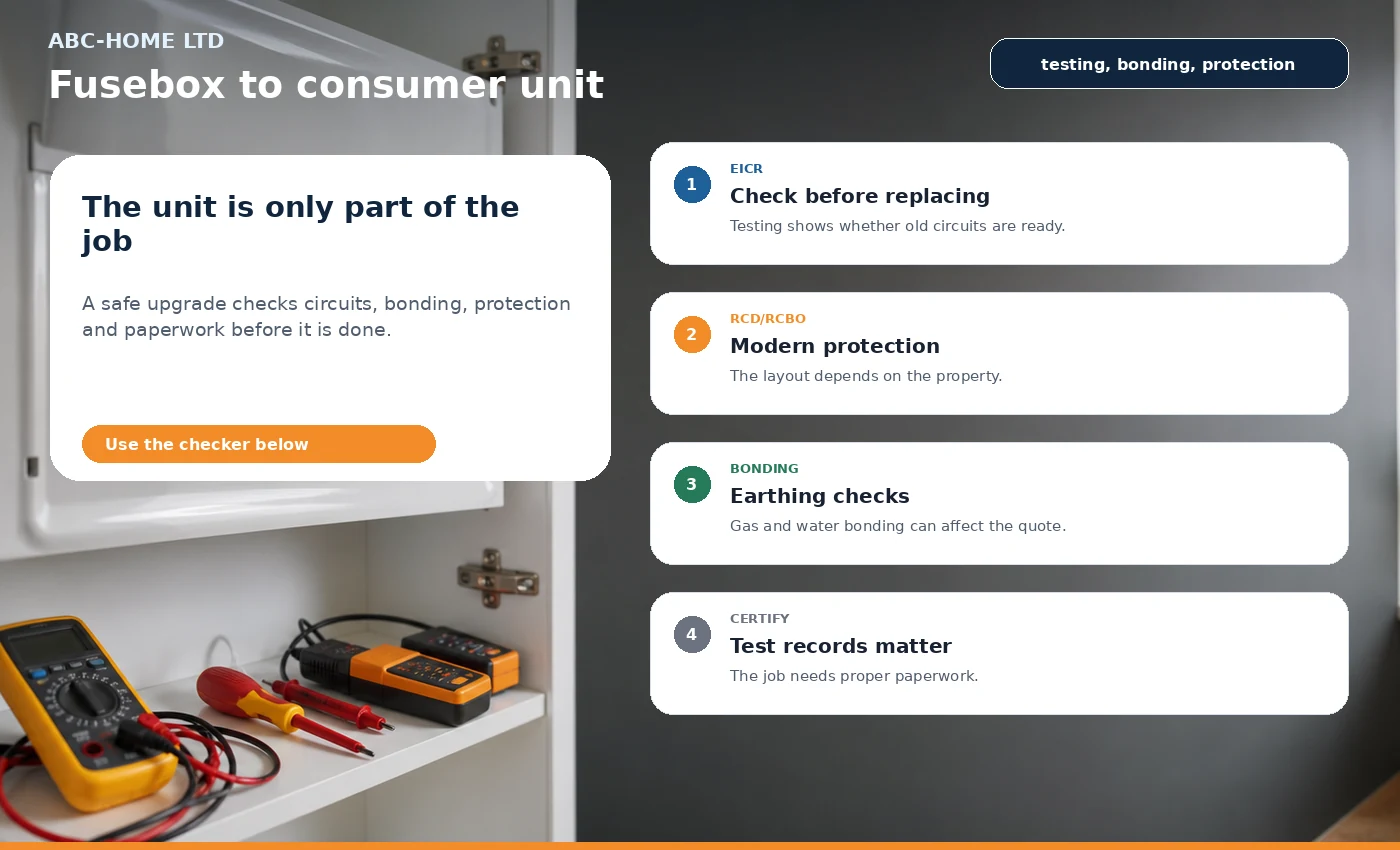
A consumer unit is the point where incoming electrical power is divided into the circuits serving a home. Replacing it is not a cosmetic box swap. The electrician has to establish whether the circuits, protective conductors, earthing and bonding are suitable for the new arrangement, then test the completed work.
This guide explains what to check before requesting a consumer unit upgrade in Aberdeen, how common protection layouts differ, and what evidence should be included in a proper quotation. It is for planning only. It does not replace inspection, testing or project-specific electrical design.
Does an old fusebox automatically need replacing?
No. Age, appearance and the material of the enclosure are not enough on their own to diagnose an unsafe installation. The decision should be based on the condition and suitability of the installation, the protection already present, test results, signs of damage or overheating, and the work planned for the property.
Electrical Safety First advises home buyers to look for the consumer unit, check whether RCD protection is present and arrange an Electrical Installation Condition Report, or EICR, by a registered electrician when a recent report is unavailable. That is a useful planning sequence for an older Aberdeen home too: establish the condition first, then define the upgrade.
Signs that justify a professional assessment
Limited or unclear RCD protection
The board may have circuit breakers but only partial residual-current protection, or labels may not show which circuits share a device.
Planned renovation work
A kitchen, extension, shower, heat-pump, EV or major rewiring project can change demand and protection requirements. The new work should be assessed as part of the whole installation.
Heat, damage or recurring faults
Discolouration, burning smells, physical damage or repeated tripping need prompt investigation. Do not remove covers or keep resetting a device that will not stay on.
Poor labels and missing records
Unclear circuit schedules, no recent report and uncertain alterations make a survey and testing more useful before a fixed-price replacement is promised.
What a consumer-unit quote should establish
| Scope item | What should be checked | Why it changes the quote |
|---|---|---|
| Existing circuits | Circuit count, identification, conductor condition and test results | A circuit with a defect may need investigation or repair before it can be reconnected. |
| Earthing and bonding | Main earthing arrangement and relevant protective bonding | Necessary remedial work can add time, materials and coordination. |
| Protection design | How overcurrent, residual-current and surge protection are arranged | A split-load, RCBO-led or other design has different equipment, fault-isolation and testing implications. |
| Supply and demand | Main switch, service position, likely maximum demand and planned new loads | Future electric heating, cooking, vehicle charging or other loads may affect the design. |
| Access and enclosure | Board location, working space, cable reach, meter area and surrounding materials | Restricted access or short conductors may turn a straightforward change into a larger job. |
| Testing and records | Pre-work checks, final verification, circuit schedule and applicable certification | These are part of a competent installation, not optional extras after the board has been fitted. |
RCD, RCBO and circuit-breaker layouts in plain English
A circuit breaker provides overcurrent protection for a circuit. An RCD monitors current flowing out and returning and disconnects the supply when it detects a qualifying imbalance. An RCBO combines residual-current and overcurrent protection for an individual circuit.
A design with individual RCBOs can reduce the number of circuits lost when one circuit develops a fault, because the fault is less likely to disconnect a shared group. That does not make one catalogue package right for every home. The protection characteristics, circuit arrangement, equipment compatibility and required additional protection should be selected by the electrician from the actual installation and the current design standard.
Surge protection should also be addressed in the quote rather than silently assumed or omitted. The correct decision belongs in the project-specific design. Ask what is included, what is not included and how that choice has been documented.
Consumer-unit upgrade readiness checker
Use this short tool to frame the next conversation. It cannot inspect the board or diagnose a circuit.
Scottish standards and certification context
The Scottish Government’s April 2026 Domestic Technical Handbook states in Standard 4.5 that an electrical installation must not threaten health and safety or become a source of fire. Its guidance says installations should safely accommodate likely maximum demand, use appropriate automatic protection against overcurrent or leakage, and provide necessary isolation. It also says electrical installations should be designed, constructed, installed and tested in accordance with BS 7671:2018 recommendations.
The same handbook describes an approved Scottish certification of construction scheme for electrical installations to BS 7671. It also makes clear that electrical installation work should be inspected and tested by people with sufficient technical knowledge, practical skills and relevant experience.
The IET identifies BS 7671 as the UK national standard for electrical installations and now presents Amendment 4:2026 as the current update. A homeowner does not need to translate every regulation into a shopping list. The useful question is whether the electrician’s design, equipment selection, testing and records follow the edition and amendment applicable to the job.
How to compare quotes without comparing only the total
- Confirm whether a survey or pre-work testing visit is included.
- Ask for the proposed protection layout and a clear circuit count.
- Check whether fault-finding and remedial work are included, provisional or excluded.
- Confirm how earthing and bonding deficiencies will be handled.
- Ask whether surge protection has been assessed and how the decision is recorded.
- Check who will perform the work and what inspection, testing and certification records you will receive.
- Confirm power-off expectations, access requirements, making-good boundaries and disposal of the old equipment.
- For a renovation, make sure the board work is coordinated with new circuits and later loads rather than priced in isolation.
A low headline price can describe a narrower job. A higher quote can include testing, RCBOs, remedial work, better labelling or coordination that the other quote excludes. Put the scope side by side before judging the difference.
Before the electrician arrives
Gather any EICR, installation certificates, extension records and notes about recurring trips. Write down planned loads such as induction cooking, an electric shower, heating equipment or vehicle charging. Make the board, meter and main bonding points accessible, but do not remove covers.
If a circuit repeatedly trips, note what was operating and when the fault appeared. Do not keep resetting it or bypass a protective device. If there is heat, smoke, arcing, a burning smell or visible damage, stop using the affected equipment and seek urgent professional help.
Frequently asked questions
Can a new consumer unit fix faults on old wiring?
No. A new unit may reveal faults when circuits are tested or when more sensitive protection is fitted. Those faults still need investigation and repair. That is why a quote should state how unexpected remedial work will be handled.
Do I need an EICR before replacement?
Not every project follows one identical sequence, but condition information is needed before existing circuits are connected to new equipment. An EICR can be a sensible first step when the installation history is unclear or a recent report is unavailable. The electrician should define the pre-work and final testing for the agreed scope.
Is an RCBO consumer unit always the best choice?
Individual RCBO protection can improve fault separation, but the correct design depends on the circuits, installation, equipment and applicable requirements. Ask for the reason behind the proposed layout rather than choosing by enclosure size or device count alone.
How long will the power be off?
That depends on the board location, number and condition of circuits, pre-work findings and remedial work. Ask the contractor to state the expected isolation period and what happens if a circuit fails testing.
Should the cheapest quote include certification?
Do not treat testing and applicable records as optional upgrades. Ask every contractor to list the inspection, testing, circuit schedule and certification or compliance evidence that will be handed over.
Sources used for this guide
- Scottish Government, Building Standards Technical Handbook: Domestic, April 2026: Standard 4.5 electrical-safety and Scottish certification context.
- IET, BS 7671 18th Edition Wiring Regulations: current UK standard and Amendment 4:2026 status.
- Electrical Safety First, home-buyer electrical checks: consumer-unit, RCD and EICR planning guidance.
- SELECT contractor FAQ: Scottish electrical-contractor assessment and certification-scheme route.
ABC Home can help coordinate the practical project route in Aberdeen. Start with our electrical services information, or contact ABC Home with the property, current board and planned renovation scope.