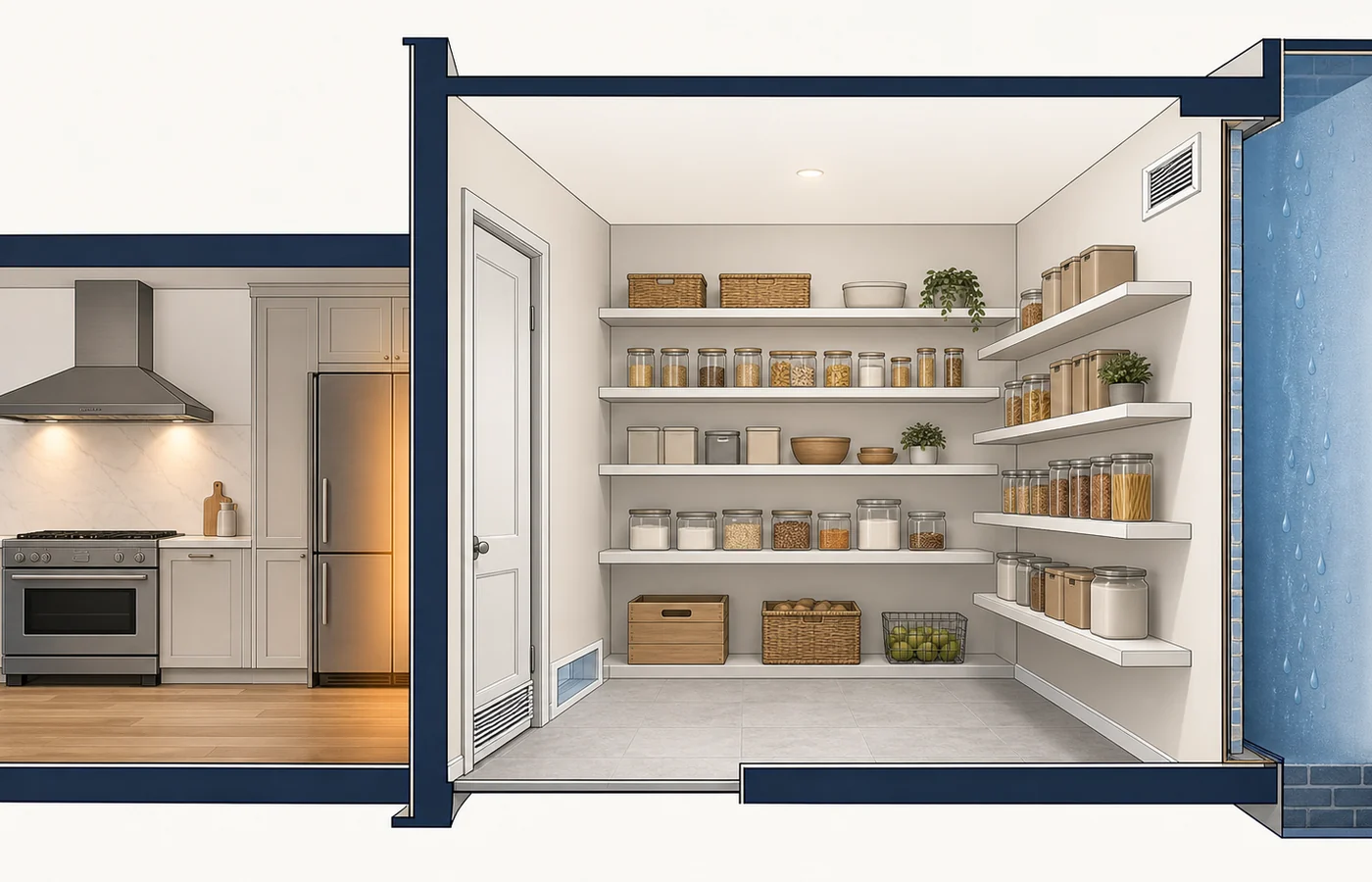
Scope: This guide covers air movement for built-in pantry cupboards and for walk-in larders or pantry rooms used as dedicated food stores.
Pantry air circulation is a practical storage issue. Start with what you are storing, where moisture comes from, where air can enter and leave, and whether the pantry is being warmed by appliances, sun or a boiler cupboard.

Pantry ventilation checker
Use this before building shelves, changing doors or boxing in a pantry during a kitchen refit.
When a simple pantry air gap is enough
| Pantry situation | Likely ventilation approach | What to check |
|---|---|---|
| Dry goods cupboard in a well-ventilated kitchen | Small door gap, normal use and good kitchen extract may be enough. | Check for stale smells after cooking and after the door has been closed overnight. |
| Walk-in pantry with no window | Transfer air through a door grille, high and low vents, or a designed connection to the room air. | Air must be able to enter and leave. One blocked grille does very little. |
| Cold external wall pantry | Gentle air movement plus insulation and moisture control. | Watch for condensation on the cold wall, especially behind stored items. |
| Pantry beside utility, sink or laundry area | Fix the moisture load first, then plan enclosed storage. | Check for condensation, cold bridging, pipe leaks and laundry moisture before adding more enclosed storage. |
| Pantry near appliances | Reduce heat first, then add airflow if needed. | Food storage gets worse if the cupboard is simply vented with warm kitchen air. |
| Pantry with bins, pet food or strong cooking odours nearby | Improve kitchen extract and separate the odour sources. | Use wipeable shelving and deal with the odour source before relying on fragrance or sealed boxes. |
| Pantry storage for root vegetables | Cool, dark, dry and lightly ventilated storage. | Do not mix damp vegetables, cleaning chemicals and open dry food on the same shelves. |
Design the air path before shelves
Air can enter through a door undercut, transfer grille, louvred panel or a planned vent. Do not rely on random gaps behind loose trim.
The same pantry also needs a return route. A single grille into a dead space can leave the cupboard stale.
Cooking steam, wet mops, leaky pipework and unvented appliances should be fixed before adding vents.
Ventilation is not cooling. Keep food away from hot appliance walls, boilers, pipe boxing and direct sun.
Walk-in larders and pantry rooms
A walk-in larder is a small room, so it needs room-scale thinking. Stale air sits in corners, and one small grille in the wrong place does very little.
- Plan both an inlet and an outlet: a door undercut or louvred panel plus a higher-level vent or a designed connection to the wider kitchen airflow.
- One low air path and one higher path usually work better than a single grille, because warmer stale air can leave at the top while cooler air enters low down.
- Under-stair and internal stores need the same in-and-out planning, even when there is no external wall.
- A direct outside vent is not automatic: badly placed, it brings cold draughts and condensation risk instead of fresh air.
- Any vent to outside should be fitted with a fine pest screen so the air path stays open without giving insects or rodents a route towards stored food.
- A larder beside a cooker, boiler, hot pipe run or sunny glazing can become too warm even if it technically has a vent, so deal with the heat source as well as the airflow.
Pantry door, vent and fan options
| Option | Good for | Not good for |
|---|---|---|
| Door undercut | Simple dry goods cupboards where the kitchen itself is ventilated. | Musty walk-in pantries or spaces with visible damp. |
| Louvred door | Moving more room air through a shallow pantry. | Keeping cooking smells, grease and dust away from open food. |
| High and low grilles | Creating a more deliberate air path in a taller cupboard or walk-in larder. | Pantries beside strong heat sources where the air is warm. |
| Small extract fan | Specific damp or odour problems after a survey. | Random installation without make-up air, noise checks and electrical planning. |
| Better kitchen extract | Stopping moisture and cooking smells at source. | Replacing a local repair where the pantry has a leak or cold-bridge issue. |
Heat, lighting and shelving details that affect airflow
Fridges, freezers and dishwashers shed heat from their backs and sides, and a pantry sharing a panel with one of them ends up with a permanently warm wall. Give the appliance its own ventilation clearance and keep temperature-sensitive food on the far side of the cupboard.
Choose LED fittings for pantry lighting. They add very little heat inside a small enclosed space, and good light makes early condensation, mould spots or softened packaging much easier to notice.
Wire racks or slatted shelves let air move between levels far better than solid boards. Where solid shelves are preferred, a small gap between the shelf and the wall keeps air moving up the back of the cupboard rather than trapping it behind stored items.
Fit fine insect mesh to external vents and to grilles opening into service spaces. An unscreened vent solves the airflow problem and creates a pest one, which matters more in a space full of food.
Monitoring, seasons and temporary measures
- Watch the hygrometer trend. A small digital hygrometer on a pantry shelf tells you more over a week than any single reading. A steady climb after cooking, laundry or a weather change points to a moisture route worth fixing; a stable line suggests the current air path is coping.
- Adjust only from evidence. Seasonal weather can change how a pantry behaves, but there is no universal summer/winter vent setting. Record temperature, humidity and condensation over time, then adjust closable vents only where the readings show a benefit; never close ventilation required for the wider room or appliance.
- Use dehumidifiers only while diagnosing. A portable dehumidifier can hold a damp pantry steady while the leak, cold bridge or extraction fault is found, but it should not become the permanent substitute for a proper air path.
- Rotate stock and clean the grilles. Rotating food brings you to every shelf, so damp packaging and mould show up early. Wipe vents and grilles when cleaning the shelves, because a dust-clogged grille passes far less air than it appears to.
When to include the pantry in a kitchen refit
- Mark the pantry location before cabinet design, not after the units are ordered.
- Check whether the door, cabinet side panels and plinth detail block the only air path.
- Keep dry goods away from heat sources and damp external corners.
- Decide whether bins, pet food, small appliances or bulk storage will share the same space.
- Make sure the kitchen extractor is specified for the room, not just chosen by style.
Practical pantry fitting notes
- Leave an air gap at the back of deep shelves so items are not pressed against cold walls.
- Do not store open food directly against external walls, uninsulated pipe boxing or appliance backs.
- Use wipe-clean shelving where dust, flour, pet food or root vegetables are stored.
- Keep cleaning chemicals separate from food and do not use the same airflow path as strong odours where possible.
- Check the kitchen extractor route at the same time. A pantry should not become the place where cooking moisture ends up.
Planning a kitchen with a larder, pantry wall or utility-linked storage? ABC Home can include ventilation, extractor position, shelving and practical storage in a kitchen fitting project in Aberdeen.
Sources and practical checks
- Scottish Government domestic technical handbook — April 2026: guidance for warrant applications submitted on or after 6 April 2026 and relevant work that does not require a warrant but starts from that date. The applicable route still needs checking for the individual project.
- Food Standards Agency Home Food Fact Checker: current public food-safety guidance for handling and storing food at home.
- Electrical Safety First: extractor fan safety: useful safety background where extractor fans, isolation and electrical work are involved.
- Centre for Sustainable Energy: condensation, damp and mould: background on condensation, ventilation and why moisture control matters in homes.
FAQ
Does a kitchen pantry need ventilation?
Not every pantry needs a powered fan, but every pantry needs a way to avoid trapped heat, damp air and stale odours. A small door gap, transfer grille, wall vent or planned connection back to the kitchen can be enough when the rest of the kitchen is dry and well extracted.
Can I put a pantry beside an oven or boiler?
It is usually a poor storage position for temperature-sensitive food. If the pantry has to sit near heat, use insulation, a small air path and shelving choices that keep food away from the warm wall.
Is a louvred pantry door better?
A louvred or vented door can help air move, but it can also carry kitchen smells into the cupboard, and it only works if the air has somewhere useful to go. Use it where moisture is the problem and avoid using it as a substitute for proper kitchen extraction.
Should a pantry vent go outside?
Not automatically. A direct outside vent can bring cold draughts or condensation risk if it is poorly placed, and it should always be pest-screened. For a kitchen refit, plan pantry airflow with the room ventilation and extractor route.
What are the warning signs of poor pantry ventilation?
Musty smells, soft cardboard, mould spots, condensation on cold surfaces, stale cooking odours, warm shelves near appliances and a hygrometer reading that keeps climbing are all signs to investigate.