Kitchen cabinet height is often described as a standard, but the fitted result is a build-up of several parts. A few millimetres at the legs, plinth or worktop can affect appliance fit and door alignment.
Use millimetres throughout the plan and confirm the finished-floor level, especially in older Aberdeen homes where floors may not be perfectly flat.
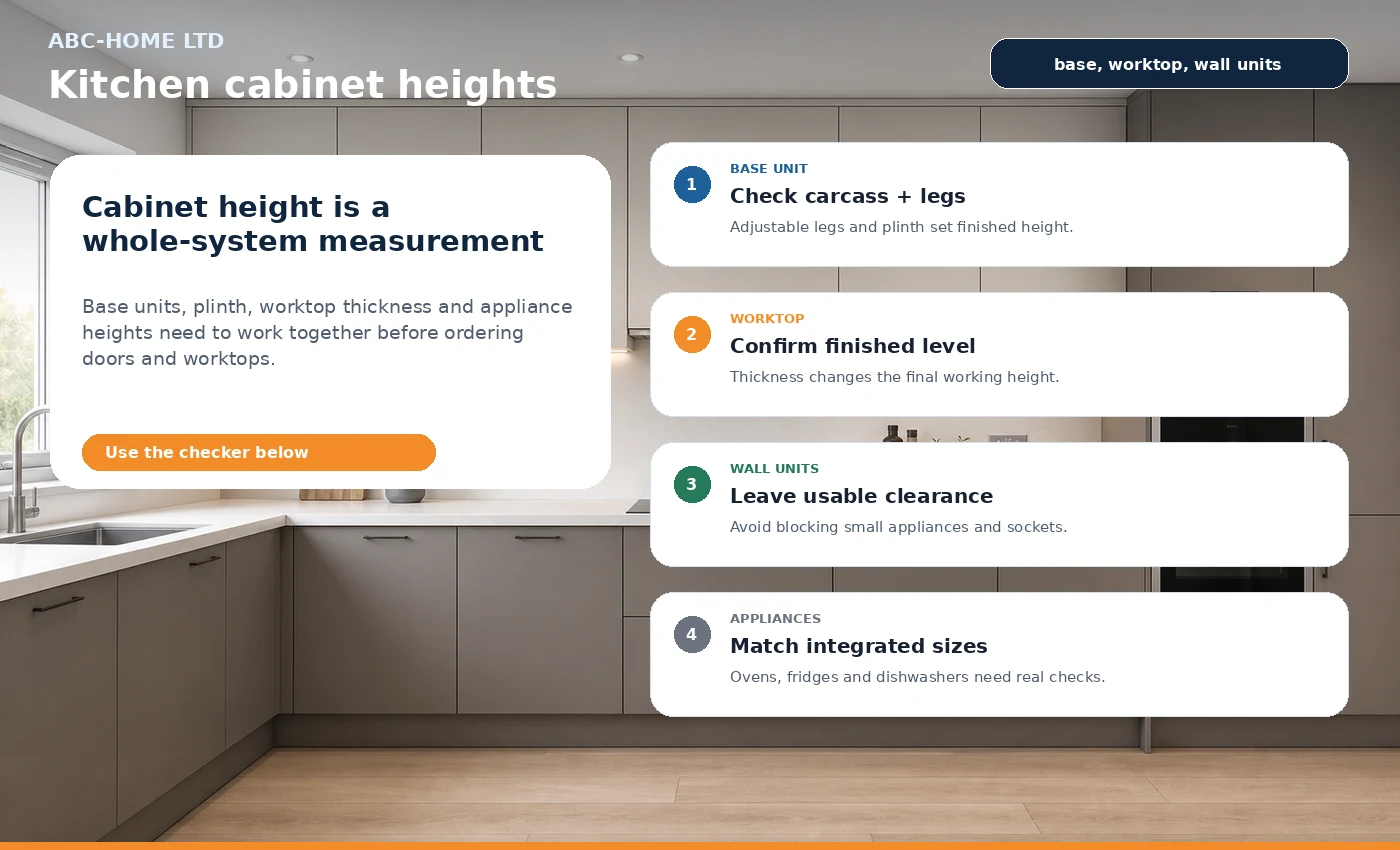
Kitchen cabinet height planning guide
| Element | Typical planning check | Why it matters |
|---|---|---|
| Finished worktop height | Often around 900mm, adjusted for product and user | This is the working surface height. |
| Base unit carcass | Check manufacturer size | Different ranges use different carcass heights. |
| Legs and plinth | Allow adjustment and a neat plinth line | Uneven floors need levelling room. |
| Wall unit clearance | Check worktop-to-wall-unit gap | Small appliances and splashback need space. |
| Integrated appliances | Confirm niche and door sizes | Appliances can control the real cabinet layout. |
Cabinet and worktop height checker
Add the parts of the cabinet build-up to check the finished worktop height.
Parts add up
Carcass, legs and worktop create the finished height.
Floor level
Older floors can change leg settings across a run.
Appliance fit
Integrated appliances often set hard limits.
Comfort check
Stand at the planned height before ordering.
Sources and checks used
- Planning Portal kitchens and bathrooms: homeowner context for kitchen work
- Scottish Government Building Standards: Scotland building standards context
- HSE manual handling: handling and fitting safety context
- HSE construction: construction safety context
FAQ
What is the standard kitchen cabinet height in the UK?
Many fitted kitchens target a worktop height around 900mm, but the final height depends on the unit range, legs, plinth, worktop and floor level.
Can kitchen base units be made higher or lower?
Usually within the adjustment range of the legs and product system, but appliance fit and plinth height can limit this.
How high should wall cabinets be above a worktop?
Set wall units so the worktop remains usable and small appliances, splashback and sockets are not blocked.
Planning work in Aberdeen? ABC Home can help connect the measurements with the practical fitting route through kitchen fitting, bathroom fitting, plumbing and electrical services.