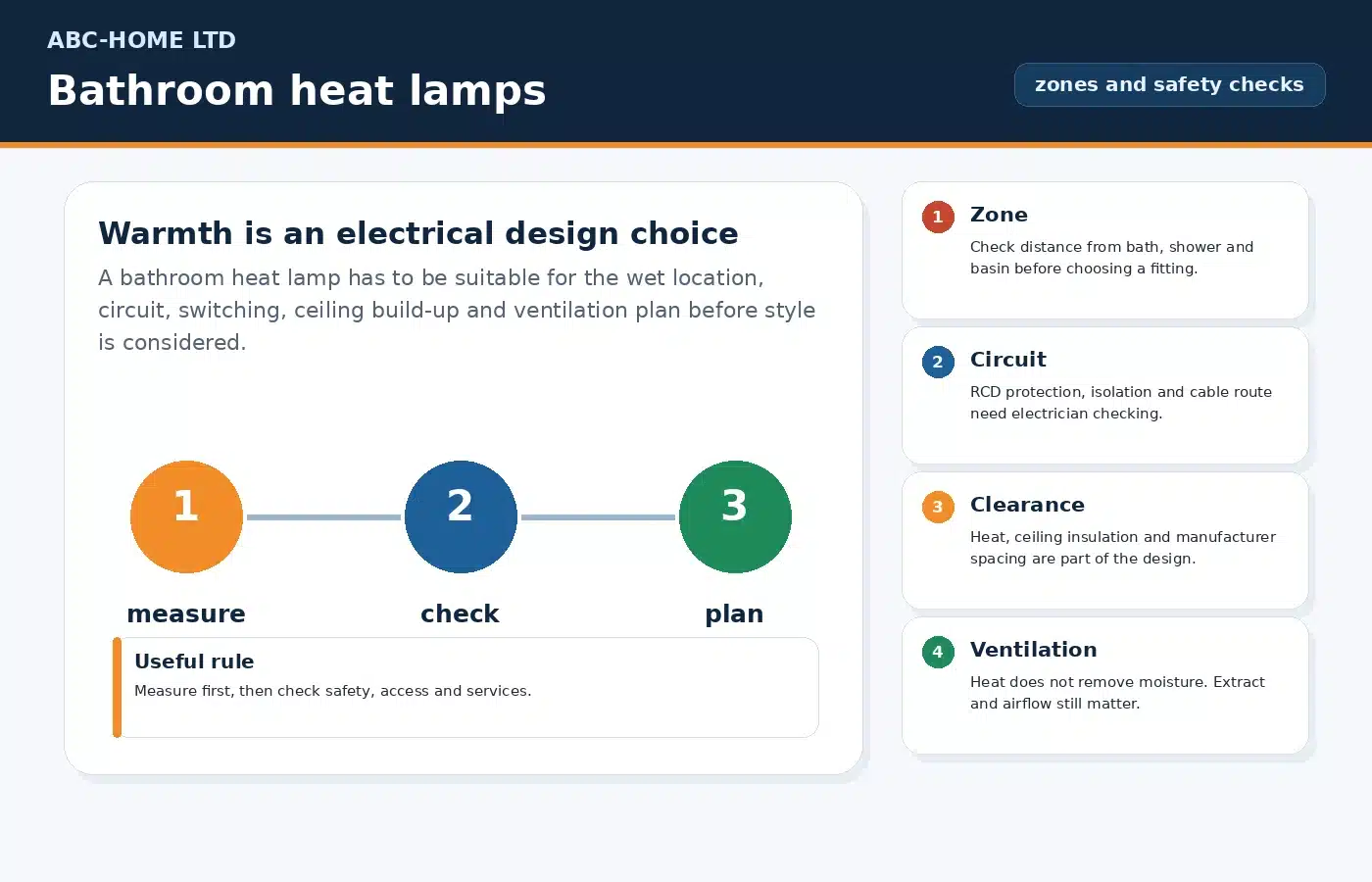
A ceiling heat lamp can give quick radiant warmth while you dry or dress. It will not warm every corner evenly and it will not remove moisture. Before buying a lamp, the useful question is not only “what wattage?” but “is this product suitable for this exact bathroom position and existing electrical installation?”

Decide what problem you are trying to solve
Bathroom heat lamp risk checker
Use this before buying a bathroom heat lamp, heater-light unit or heat bulb fitting.
This checker is a planning prompt, not a design or compliance decision. The electrician still needs the room dimensions, product instructions, circuit details and access above the ceiling.
What to check before buying a fitting
| Check | What the installer needs to establish | Reason to pause |
|---|---|---|
| Exact position | Where the fitting sits in relation to the bath, shower, basin, ceiling height and likely spray. | The only proposed position is exposed to direct spray or has not been measured. |
| Product suitability | The manufacturer’s bathroom-use, location, mounting and lamp instructions for that exact model. | It is only a heat bulb or generic holder with no clear bathroom or enclosure information. |
| Circuit and protection | Existing circuit condition, maximum demand, protective devices, RCD provision, isolation and test results. | The plan assumes an old lighting point is automatically suitable for the new load and fitting. |
| Ceiling and heat clearance | Required clearances from insulation, timber, boards, covers and other heat-sensitive materials. | The ceiling void is cramped, insulated or inaccessible and the product gives no workable clearance. |
| Controls | A safe switching and isolation arrangement for use and maintenance. | A normal switch or improvised control is proposed without checking its location and suitability. |
| Ventilation | Whether the extract system and replacement airflow already manage moisture. | Condensation, mould or long drying times are being treated as a heating-only problem. |
A heat lamp may be useful when
- You want short, direct warmth rather than all-day room heating.
- A bathroom-suitable product has clear installation instructions.
- The electrician can find a workable position and verify the supply and protection.
- The ventilation already deals with normal shower or bath moisture.
Choose another approach when
- The room needs steady background heat or warm towels.
- The proposed fitting has no clear bathroom suitability.
- The ceiling void cannot provide the stated heat clearances.
- Damp, mould or weak extract is the main complaint.
Heat lamp, bathroom fan heater or towel radiator?
| Option | What it does well | What still needs checking |
|---|---|---|
| Fixed ceiling heat lamp | Fast radiant warmth over a small area. | Product and position suitability, circuit protection, isolation, heat clearances and ceiling access. |
| Fixed bathroom fan heater | Short burst of warm air and quicker whole-room effect. | Bathroom suitability, location, controls, noise and safe fixed wiring. |
| Electric towel radiator | Dry towels and steady background comfort. | Output, controls, mounting position and bathroom electrical design. |
| Heating plus better extract | Addresses comfort and moisture as two separate needs. | Fan duty, duct route, replacement air and how the room is normally heated. |
A practical fitting sequence
- Mark the bath, shower, basin and intended ceiling position on a measured plan.
- Decide whether you need radiant warmth, warm air, towel drying, background heating or better moisture control.
- Choose a product with clear manufacturer information for bathroom use, mounting and heat clearance.
- Ask a competent electrician to assess the position, supply, protection, isolation, maximum demand and test requirements.
- Coordinate the fitting with insulation, ceiling boards, extract ducting, joists and access for future maintenance.
- Keep the product instructions and the electrical inspection or test documentation supplied for the completed work.
How the electrical rules work in Scotland
For Scottish homes, the relevant building-standards route is the Building (Scotland) Regulations 2004 and the Scottish domestic technical handbook. The April 2026 domestic handbook applies to building-warrant applications submitted on or after 6 April 2026 and to work not requiring a warrant from that date, subject to its transitional provisions.
Mandatory Standard 4.5 is about electrical safety. In practical terms, the installation must not threaten health and safety or become a source of fire, must accommodate likely maximum demand, and must include appropriate protection and a means of isolation. The handbook says electrical installations should be designed, constructed, installed and tested in accordance with BS 7671:2018, and inspected and tested by people with sufficient technical knowledge. Standard 4.6.1 also calls for a lighting point in every bathroom.
That is why a web page cannot decide that a heat lamp is suitable from a product label or one room measurement alone. The final choice depends on the current standard selected for the project, the room geometry, the fitting’s instructions, circuit condition, protective devices, heat clearances and test results.
Sources used for this Scottish guide
- Scottish Government: Building standards technical handbook, domestic, April 2026 — Scotland-only applicability, Standard 4.5 electrical safety and Standard 4.6.1 lighting guidance.
- IET: ensure you are up to date with BS 7671 — the A4:2026 transition and 15 October 2026 cut-off for the previous edition.
- Electrical Safety First: bathroom electrical safety — homeowner context on why wet conditions increase electrical risk. Scotland-specific regulatory claims on this page are grounded in the Scottish handbook above.
FAQ
Can you install a heat lamp in a bathroom?
Yes, but it should be a fixed bathroom-suitable fitting in a position assessed for the room and product. A competent electrician should check the circuit, protection, isolation, heat clearances and manufacturer instructions against the current wiring rules and the Scottish building standards route for the project.
Can a heat lamp replace bathroom ventilation?
No. A heat lamp can give quick radiant warmth, but it does not remove water vapour. Condensation, mould or slow drying point to an extract and airflow problem that needs its own assessment.
Is a plug-in heat lamp safe in a bathroom?
Do not take a normal portable plug-in lamp or heater into a bathroom. If extra heat is needed, use fixed equipment selected for the bathroom and have its location, supply and controls checked by a competent electrician.