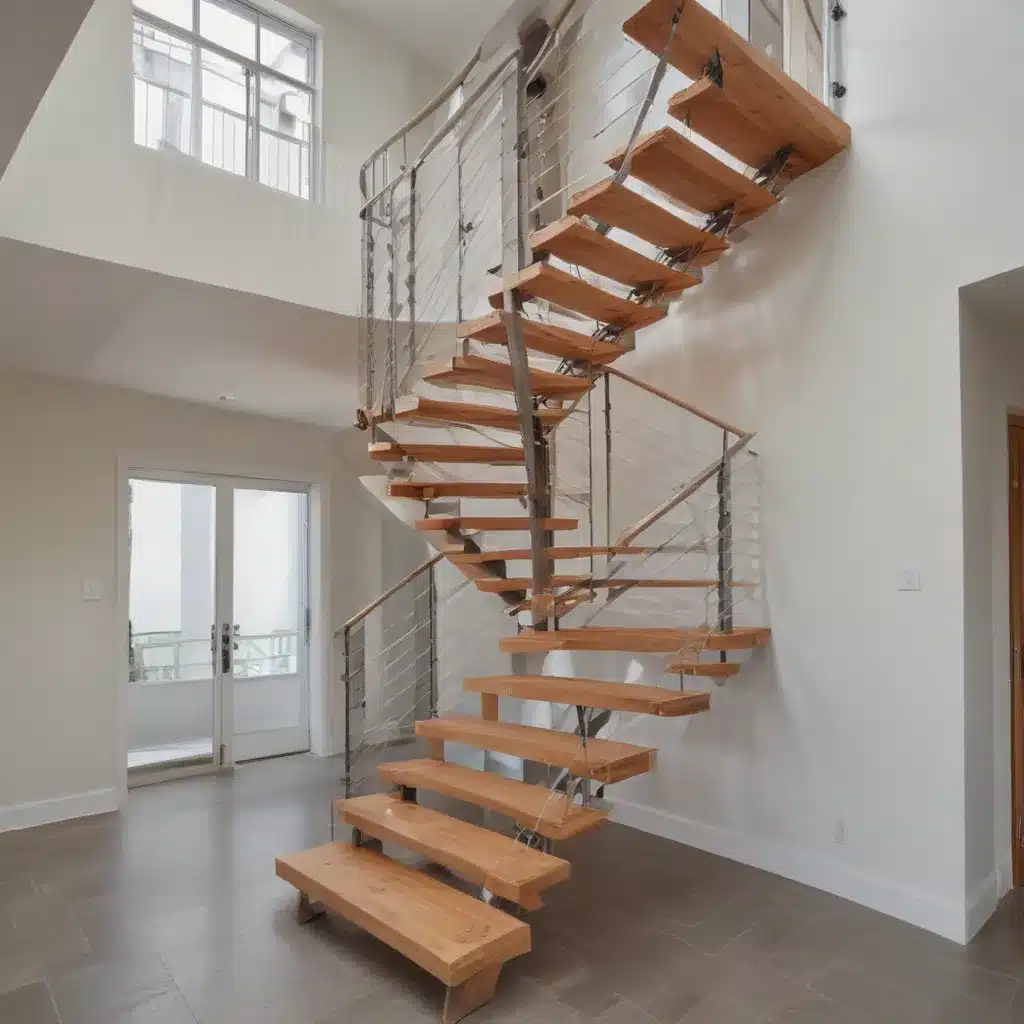
The Staircase Conundrum: Navigating the Complexities of Design and Regulation
Ah, the humble staircase – a seemingly simple structure that has captivated architects, builders, and homeowners alike for centuries. But don’t be fooled, my friends. Designing a staircase that not only looks aesthetically pleasing but also meets the rigorous building codes can be a true test of one’s skill and patience.
As the owner of ABC Home, a building and renovation company in Aberdeen, UK, I’ve had the privilege of tackling countless staircase projects over the years. And let me tell you, it’s not always a walk in the park. But fear not, for I’m here to guide you through the labyrinth of staircase design and regulation, one step at a time.
Understanding the Basics: Staircase Anatomy and Terminology
Before we dive into the nitty-gritty of staircase design, it’s important to familiarize ourselves with the key components and terminology. After all, how can we expect to navigate the building code maze if we don’t even know the difference between a tread and a riser?
Let’s start with the basics: a staircase is composed of a series of steps, with each step consisting of a tread (the horizontal surface you step on) and a riser (the vertical surface connecting one tread to the next). The angle at which these treads and risers are arranged is known as the staircase’s pitch or slope.
But wait, there’s more! We’ve also got the stringers, the structural supports that run along the sides of the staircase, and the handrails, those all-important safety features that ensure you don’t take a tumble as you ascend or descend.
Navigating this staircase lexicon might feel like a game of Scrabble, but trust me, it’s essential knowledge if you want to design a staircase that ticks all the boxes.
Decoding the Building Codes: Regulatory Requirements for Staircase Design
Now that we’ve got the lingo down, let’s dive into the world of building codes. Oh boy, buckle up, folks, because this is where things can get a bit, shall we say, complicated.
You see, the building codes in the UK are designed to ensure the safety and accessibility of all structures, and staircases are no exception. These regulations cover a wide range of requirements, from the minimum and maximum step dimensions to the necessary clearances and handrail specifications.
But it doesn’t stop there. Depending on the type of building and its intended use, there may be additional code requirements to consider. For example, a staircase in a commercial building might need to meet different standards than one in a private residence.
And don’t even get me started on the variations between different local authorities! It’s enough to make your head spin.
Navigating the Labyrinth: Practical Considerations for Staircase Design
Ah, but the fun doesn’t stop there. Once you’ve got the building codes under your belt, you’ve still got a whole host of practical considerations to tackle when it comes to designing a staircase.
For instance, have you ever thought about the impact of the staircase’s location within the building? The available space, the flow of foot traffic, and even the building’s overall aesthetic all play a crucial role in determining the optimal staircase design.
And let’s not forget about the materials. Sure, we all love the look of a sleek, modern glass staircase, but have you considered the structural integrity and maintenance requirements? Timber, steel, and even concrete each have their own unique advantages and challenges.
And let’s not forget about the all-important question of accessibility. After all, staircases aren’t just for the able-bodied. Designing a staircase that accommodates individuals with mobility challenges or disabilities is a must-have in today’s inclusive society.
Putting it All Together: A Case Study in Staircase Design
Alright, enough with the theory – let’s get down to the nitty-gritty of staircase design. And what better way to do that than by diving into a real-life case study?
Let’s take a look at a recent project we completed for a private residence in the heart of Aberdeen. The homeowners, a lovely couple in their 60s, had purchased a charming Victorian-era townhouse and were looking to modernize the interior while preserving the original character.
One of the key challenges they faced was the narrow, winding staircase that connected the upper and lower floors. It was a real head-scratcher, let me tell you. Not only did we need to ensure the staircase met all the relevant building codes, but we also had to find a way to make it feel light and airy, without compromising the historic charm of the home.
After countless iterations and discussions with the homeowners, we landed on a design that incorporated a sleek, glass-paneled balustrade, which allowed natural light to flood the space and create the illusion of a more open, spacious layout. And let me tell you, the end result was simply stunning – a perfect blend of modern elegance and timeless elegance.
But the real triumph? When the local building inspector came to inspect the finished staircase, they were practically gushing with praise. “Easily one of the most well-designed and code-compliant staircases I’ve seen in years,” they remarked. And let me tell you, that’s a compliment we wear like a badge of honor.
Embracing the Unexpected: Overcoming Staircase Design Challenges
Of course, not every staircase project is as smooth sailing as the one I just described. Sometimes, the unexpected rears its head, and we’re left scratching our heads, wondering how on earth we’re going to find a solution.
Take, for example, the case of the historic manor house we were commissioned to renovate a few years back. The existing staircase was an absolute architectural marvel, with intricate carvings and a sweeping, spiral design that had been the centerpiece of the home for centuries.
But there was a catch – it didn’t quite meet the current building codes. The treads were a tad too narrow, the risers were a smidge too tall, and the handrails were, well, let’s just say they were more ornamental than functional.
Now, most people would have simply ripped out the old staircase and started from scratch. But not us. Oh no, we were determined to find a way to preserve the historic charm of this architectural gem while bringing it up to code.
After weeks of meticulous planning and consultations with the local heritage council, we came up with a solution that involved carefully modifying the existing staircase, reinforcing the structure, and adding discreet safety features that blended seamlessly with the original design.
The end result? A staircase that not only met all the necessary building regulations but also remained a stunning focal point of the home, a testament to the skill and creativity of our team.
Embracing the Art of Staircase Design
You know, as I reflect on all the staircase projects I’ve been a part of over the years, I can’t help but feel a deep sense of appreciation for the art of staircase design. It’s not just about meeting the building codes and ticking boxes – it’s about crafting a functional, beautiful, and safe piece of architecture that breathes life into a space.
And let me tell you, it’s a delicate balance. Too often, I’ve seen staircases that are either so painfully utilitarian that they suck the joy out of a room, or so ornate and over-the-top that they feel more like a museum piece than a practical means of getting from one floor to the next.
But when you strike that perfect harmony – when the form and function come together in a seamless, elegant dance – that’s when the magic happens. That’s when you create a staircase that not only serves its purpose but also becomes a true work of art, a centerpiece that draws the eye and captivates the soul.
And you know what? I live for that feeling. The thrill of tackling a complex design challenge, the satisfaction of finding a solution that exceeds all expectations, and the pure joy of seeing a client’s face light up when they step into their brand-new, beautifully designed staircase – it’s what gets me out of bed in the morning.
So, if you’re embarking on a building or renovation project and you’re feeling a bit daunted by the prospect of designing a staircase, take heart. With a little bit of elbow grease, a whole lot of creativity, and a deep understanding of the building codes, you can create a staircase that not only meets the necessary requirements but also becomes a true work of art.
And who knows, maybe one day, your staircase will be the talk of the town, just like the one we designed for that lovely couple in Aberdeen. After all, the sky’s the limit when it comes to the art of staircase design.
Conclusion: Embrace the Challenge, Unleash Your Creativity
So there you have it, folks – a deep dive into the world of staircase design and the intricate dance of building codes, practical considerations, and creative problem-solving. It’s a journey that’s equal parts exciting and daunting, but one that’s well worth the effort.
As the owner of ABC Home, I can attest to the immense satisfaction that comes from crafting a staircase that not only meets the necessary regulations but also captures the hearts and imaginations of our clients. It’s a true testament to the power of design, the importance of attention to detail, and the joy of problem-solving.
So, if you’re embarking on a building or renovation project and you’re feeling a bit daunted by the prospect of designing a staircase, take a deep breath and embrace the challenge. With the right approach, a keen eye for detail, and a healthy dose of creativity, you can create a staircase that not only serves its purpose but also becomes a true work of art.
And who knows, maybe one day, your staircase will be the talk of the town, just like the ones we’ve designed for our clients here at ABC Home. After all, the sky’s the limit when it comes to the art of staircase design.
So, what are you waiting for? Let’s get started on your staircase journey today! Visit our website to learn more about our building and renovation services, and let’s work together to create a staircase that will have your guests in awe.