Kitchen cabinet height UK: base unit standards and fitting dimensions

Quick answer: most UK kitchen base cabinets are planned around a finished worktop height of about 900mm. The common stack is a 720mm base carcass, a 100 to 150mm plinth and a 20 to 40mm worktop. Wall cabinets often start about 450 to 500mm above the worktop, while tall units are commonly around 1970 to 2150mm depending on the room and product range.

These are practical fitting dimensions, not a legal minimum. The right answer still depends on the people using the kitchen, the appliance housings, floor level, ceiling height and the exact unit system being fitted.

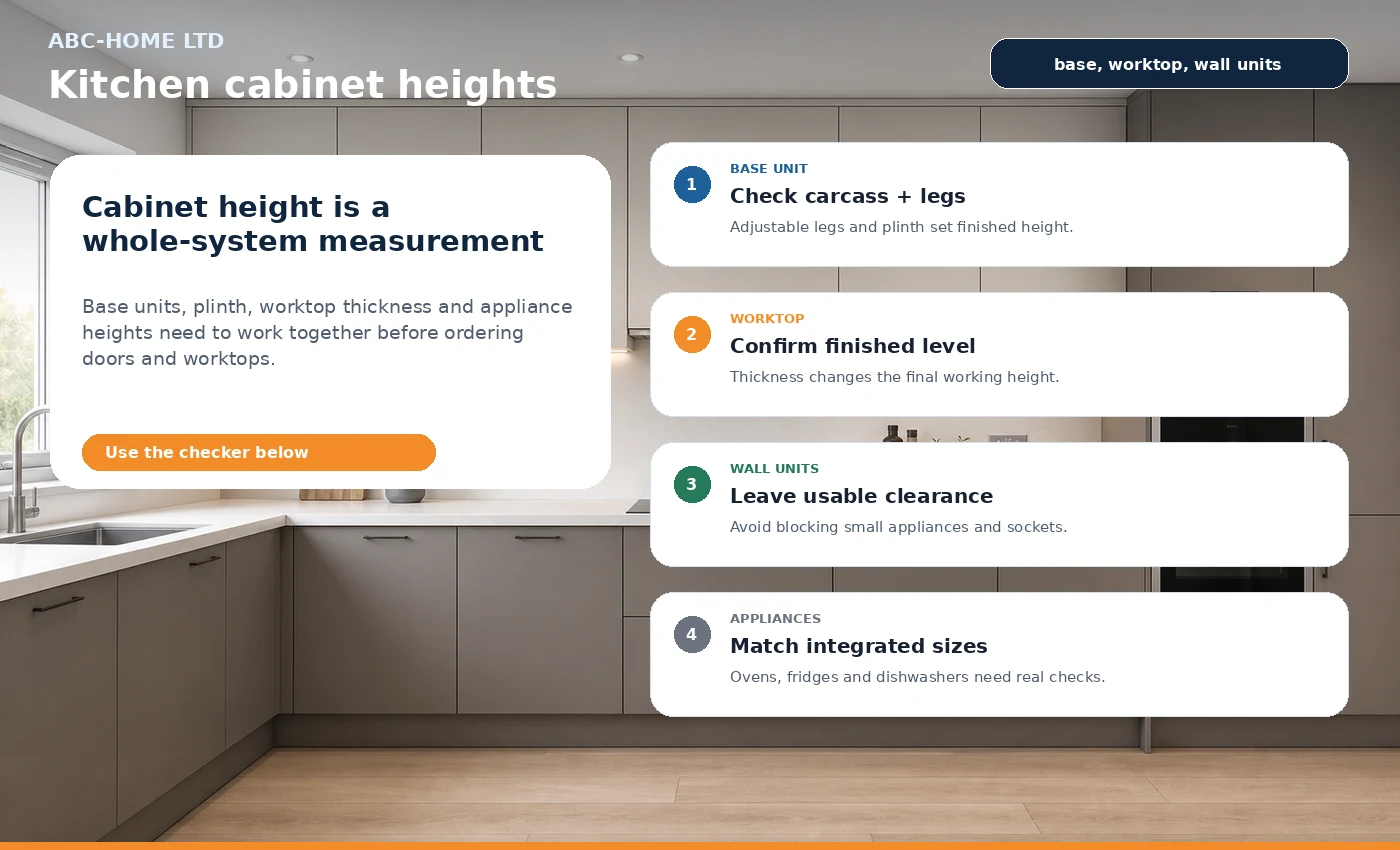
Kitchen cabinet height UK diagram showing base units, wall units, tall units and common fitting dimensions
Typical UK kitchen cabinet height planning bands. Check the exact cabinet system and appliance manuals before ordering panels.

Common UK kitchen cabinet heights

Item Common planning size What to check before fitting
Finished worktop height 870 to 920mm, often close to 900mm User height, floor level, plinth adjustment and worktop thickness.
Base unit carcass Usually 720mm Some ranges use different systems, especially handleless or compact kitchens.
Plinth height 100 to 150mm Allows leg adjustment and hides uneven floors. Do not forget ventilation needs for appliances.
Worktop thickness 20 to 40mm typical Laminate, quartz, timber and compact laminate change the finished height.
Wall unit bottom above worktop 450 to 500mm Kettle, toaster, mixer, splashback, hob clearance and reach.
Tall unit height 1970 to 2150mm common Ceiling height, cornice, filler panels, fridge housing and oven housing.
Toe kick recess About 50 to 75mm deep Comfort when standing at the worktop and room for plinth clips.

How to choose the right worktop height

The standard answer is useful for ordering, but it is not always the best answer for the room. If the main user is shorter, a very high worktop can make chopping and kneading awkward. If the user is tall, a low worktop can feel uncomfortable. In most refits, the practical range is small because appliance housings, plinths and cabinet systems are built around set sizes.

  • Start with the cabinet system. Do not assume every range uses the same carcass height.
  • Allow for the actual finished floor. New tiles, levelling compound or LVT can change the final height.
  • Check appliances before worktops are cut. Integrated dishwasher, washing machine and fridge housings can control the finished line.
  • Think about the first shelf in the wall units. A beautiful line is not much use if the storage is hard to reach.

Kitchen base unit standards in one table

Kitchen base unit standards are mainly product and fitting conventions. They help the worktop, plinth, appliances and wall units line up, but they are not one legal size for every home. Use the table below as a practical UK planning check before ordering cabinets or panels.

Base unit item Common UK planning size Fitting check
Base carcass height Usually 720mm Check the exact range. Handleless, compact and bespoke systems can differ.
Finished worktop height Often close to 900mm overall Carcass plus plinth plus worktop thickness gives the final height.
Standard depth About 560 to 600mm before worktop overhang Check pipe routes, appliance depth, service voids and door/drawer clearance.
Common widths Often 300, 400, 500, 600, 800 or 1000mm modules Plan sink base, dishwasher, oven housing and corner access together.
Plinth and toe space Usually 100 to 150mm high with a recessed kick space Uneven floors and integrated appliance ventilation can change the detail.
Aberdeen fitting note: the showroom plan should still be checked against the actual room. Old floors, out-of-square corners, boxing, stop taps and appliance services can all change how standard base units fit.

Base unit width, depth and appliance checks

For a normal refit, the safest approach is to confirm the cabinet system first, then lock the appliance sizes, then check the worktop and plinth line. A 600mm appliance gap, a 600mm sink base and a 600mm drawer pack are not interchangeable once hinges, end panels, handles, pipework and service access are included.

  • Sink base: check bowl width, waste route, tap tails and any boiling-water or filter equipment.
  • Appliance run: check dishwasher, washer and oven manuals before the worktop is templated.
  • Corner unit: check door swing and access hardware before assuming a standard width will work.
  • Toe kick: use the detailed kitchen toe kick dimensions guide when trimming plinths or planning appliance ventilation.

If the units, worktop and appliances all need to land cleanly, ABC Home can measure and fit the kitchen as part of a kitchen fitting project in Aberdeen.

Kitchen cabinet height checker

Use this as a quick sense-check before ordering panels. It does not replace the manufacturer’s plan, but it catches the obvious height problems.

Enter your cabinet sizes and press the button.

When to move away from the standard size

Move away from the standard only when there is a clear reason: accessibility, unusual appliances, a very uneven floor, a low ceiling, a thick worktop or a specific design choice. For accessible layouts, check the relevant accessibility guidance rather than copying a standard kitchen showroom plan.

Useful source: GOV.UK Approved Document M covers access to and use of buildings. It does not set a normal kitchen showroom height, but it is a better reference point when accessibility is part of the brief.

FAQ

What is the standard kitchen worktop height in the UK?

Around 900mm is the common planning answer. In practice, 870 to 920mm covers many fitted kitchens once carcass, plinth and worktop thickness are combined.

How high should wall cabinets be above a kitchen worktop?

About 450 to 500mm is a common starting point. Go lower only if reach matters more than appliance clearance, and go higher only if the user can still access the storage.

Are kitchen cabinet heights controlled by Building Regulations?

Normal kitchen cabinet heights are mainly product and fitting dimensions. Regulations may matter for access, ventilation, electrics, drainage and safety, but they do not give one standard cabinet height for every home.

Should tall units go right to the ceiling?

They can, but only if the room is measured carefully. Leave room for floor unevenness, ceiling variation, cornice, filler panels and installation tolerance.

If you want the kitchen measured properly before ordering, ABC Home can help with kitchen fitting in Aberdeen.


Facebook
Twitter
LinkedIn
Pinterest
Reddit

Leave a Reply

Your email address will not be published. Required fields are marked *