.abc-upgrade{max-width:980px;margin:0 auto;font-size:18px;line-height:1.62;color:#1f2937}.abc-upgrade p{margin:0 0 1rem}.abc-upgrade h2{font-size:1.65rem;margin:2rem 0 .75rem;color:#10263f}.abc-upgrade h3{font-size:1.25rem;margin:1.4rem 0 .55rem;color:#10263f}.abc-answer{background:#f3f7fb;border-left:6px solid #f28c28;padding:1rem 1.15rem;border-radius:14px;margin:0 0 1.25rem}.abc-note{background:#fff8ed;border:1px solid #f4c27d;padding:1rem;border-radius:14px}.abc-warning{background:#fff2f0;border:1px solid #ef9a8c;padding:1rem;border-radius:14px}.abc-grid{display:grid;grid-template-columns:repeat(2,minmax(0,1fr));gap:1rem}.abc-card{background:#fff;border:1px solid #d7dee8;border-radius:16px;padding:1rem}.abc-table{width:100%;max-width:100%;table-layout:fixed;border-collapse:collapse;margin:1rem 0;background:#fff;overflow-wrap:anywhere}.abc-table th,.abc-table td{border:1px solid #d7dee8;padding:.75rem;text-align:left;vertical-align:top;overflow-wrap:anywhere;word-break:break-word}.abc-table th{background:#10263f;color:#fff}.abc-figure{margin:1.25rem 0}.abc-figure img{width:100%;height:auto;border-radius:18px;border:1px solid #d7dee8}.abc-figure figcaption{font-size:.95rem;color:#526173;margin-top:.45rem}.abc-tool{border:2px solid #1f5f99;background:#f6f8fb;border-radius:18px;padding:1rem;margin:1.25rem 0}.abc-tool label{display:block;font-weight:700;margin:.8rem 0 .25rem;color:#10263f}.abc-tool input,.abc-tool select{width:100%;max-width:420px;padding:.65rem;border:1px solid #b8c3d1;border-radius:10px}.abc-tool button{margin-top:1rem;background:#f28c28;color:#111827;border:0;border-radius:999px;padding:.75rem 1.2rem;font-weight:800;cursor:pointer}.abc-result{display:block;margin-top:1rem;background:#fff;border:1px solid #d7dee8;border-radius:14px;padding:1rem}.abc-cta{background:#10263f;color:#fff;border-radius:18px;padding:1.15rem;margin:1.5rem 0}.abc-cta a{color:#fff;text-decoration:underline;font-weight:800}.abc-source-list li{margin:.35rem 0}@media(max-width:760px){.abc-upgrade{font-size:16px}.abc-grid{grid-template-columns:1fr}.abc-table{font-size:15px}.abc-table th,.abc-table td{padding:.55rem}.abc-tool input,.abc-tool select{max-width:100%}}
.abc-link-grid{display:grid;grid-template-columns:repeat(2,minmax(0,1fr));gap:.8rem;margin:1rem 0}.abc-link-grid a{display:block;background:#fff;border:1px solid #d7dee8;border-radius:14px;padding:.85rem;font-weight:800;color:#10263f}.abc-pill-list{display:flex;flex-wrap:wrap;gap:.5rem;margin:1rem 0}.abc-pill-list span{background:#eaf3ff;border:1px solid #b8cfea;color:#10263f;border-radius:999px;padding:.35rem .65rem;font-weight:700}.abc-mini{font-size:.95rem;color:#526173}.abc-step-list li{margin:.55rem 0}.abc-tool details{background:#fff;border:1px solid #d7dee8;border-radius:14px;padding:.75rem;margin:.8rem 0}.abc-tool summary{font-weight:800;cursor:pointer}.abc-two-col{columns:2;column-gap:2rem}.abc-two-col li{break-inside:avoid;margin:.4rem 0}@media(max-width:760px){.abc-link-grid{grid-template-columns:1fr}.abc-table{font-size:14px}.abc-tool input,.abc-tool select{max-width:100%}.abc-two-col{columns:1}}
.abc-tool label{display:block;font-weight:800;margin:.75rem 0 .25rem;color:#10263f}.abc-tool input,.abc-tool select{width:100%;max-width:460px;padding:.65rem;border:1px solid #b8cfea;border-radius:10px}.abc-tool button{margin-top:.9rem;background:#f28c28;color:#fff;border:0;border-radius:999px;padding:.7rem 1.05rem;font-weight:900;cursor:pointer}.abc-result{display:block;margin-top:.85rem;background:#10263f;color:#fff;border-radius:14px;padding:.85rem 1rem;font-weight:700;line-height:1.45}.abc-choice-grid{display:grid;grid-template-columns:repeat(2,minmax(0,1fr));gap:.9rem;margin:1rem 0}.abc-choice-grid>div{background:#fff;border:1px solid #d7dee8;border-radius:14px;padding:1rem}.abc-choice-grid strong{display:block;color:#10263f;margin-bottom:.25rem}.abc-compare-grid{display:grid;grid-template-columns:1fr 1fr;gap:1rem;margin:1rem 0}.abc-compare-grid>div{background:#fff;border:1px solid #d7dee8;border-radius:14px;padding:1rem}.abc-compare-grid h3{margin-top:0}.abc-source-list li{margin:.45rem 0}.abc-soft-note{background:#f3f7fb;border:1px solid #cfe0f5;border-radius:14px;padding:1rem;margin:1rem 0}.abc-warning-soft{background:#fff7ed;border:1px solid #fed7aa;border-radius:14px;padding:1rem;margin:1rem 0}.abc-step-list li{margin:.55rem 0}@media(max-width:760px){.abc-choice-grid,.abc-compare-grid{grid-template-columns:1fr}.abc-tool input,.abc-tool select{max-width:100%}.abc-table{font-size:14px}}
.abc-tool label{display:block;font-weight:800;margin:.75rem 0 .25rem;color:#10263f}.abc-tool input,.abc-tool select{width:100%;max-width:560px;padding:.65rem;border:1px solid #b8cfea;border-radius:10px}.abc-tool button{margin-top:.9rem;background:#f28c28;color:#fff;border:0;border-radius:999px;padding:.7rem 1.05rem;font-weight:900;cursor:pointer}.abc-result{display:block;margin-top:.85rem;background:#10263f;color:#fff;border-radius:14px;padding:.85rem 1rem;font-weight:700;line-height:1.45}.abc-check-grid{display:grid;grid-template-columns:repeat(2,minmax(0,1fr));gap:.9rem;margin:1rem 0}.abc-check-grid>div{background:#fff;border:1px solid #d7dee8;border-radius:14px;padding:1rem}.abc-check-grid strong{display:block;color:#10263f;margin-bottom:.25rem}.abc-compare-grid{display:grid;grid-template-columns:1fr 1fr;gap:1rem;margin:1rem 0}.abc-compare-grid>div{background:#fff;border:1px solid #d7dee8;border-radius:14px;padding:1rem}.abc-compare-grid h3{margin-top:0}.abc-source-list li{margin:.45rem 0}.abc-soft-note{background:#f3f7fb;border:1px solid #cfe0f5;border-radius:14px;padding:1rem;margin:1rem 0}.abc-warning-soft{background:#fff7ed;border:1px solid #fed7aa;border-radius:14px;padding:1rem;margin:1rem 0}.abc-step-list li{margin:.55rem 0}.abc-kpi-row{display:flex;flex-wrap:wrap;gap:.65rem;margin:1rem 0}.abc-kpi-row span{background:#eaf3ff;border:1px solid #b8cfea;border-radius:999px;padding:.45rem .75rem;font-weight:800;color:#10263f}.abc-mini-matrix{display:grid;grid-template-columns:repeat(3,minmax(0,1fr));gap:.75rem;margin:1rem 0}.abc-mini-matrix>div{background:#fff;border:1px solid #d7dee8;border-radius:14px;padding:.9rem}.abc-mini-matrix strong{display:block;color:#10263f}.abc-badges{display:flex;flex-wrap:wrap;gap:.5rem;margin:1rem 0}.abc-badges span{background:#10263f;color:#fff;border-radius:999px;padding:.4rem .7rem;font-weight:800}.abc-small{font-size:.95rem;color:#526173}@media(max-width:760px){.abc-check-grid,.abc-compare-grid,.abc-mini-matrix{grid-template-columns:1fr}.abc-tool input,.abc-tool select{max-width:100%}}
Stud spacing is only useful if it helps you fix something safely. In a kitchen, that may be a full wall unit, rail, shelf, microwave bracket or even a boiler cupboard, so a guessed stud position is a poor plan.
Stud spacing matters, but it is not the final decision. A 600mm-centre timber stud wall, a metal stud partition, dot-and-dab plasterboard over masonry and a solid brick wall all need different fixing judgement. Add kitchen cables, water pipes and splashback finishes and the job becomes a structure and services check, not just a tape-measure trick.
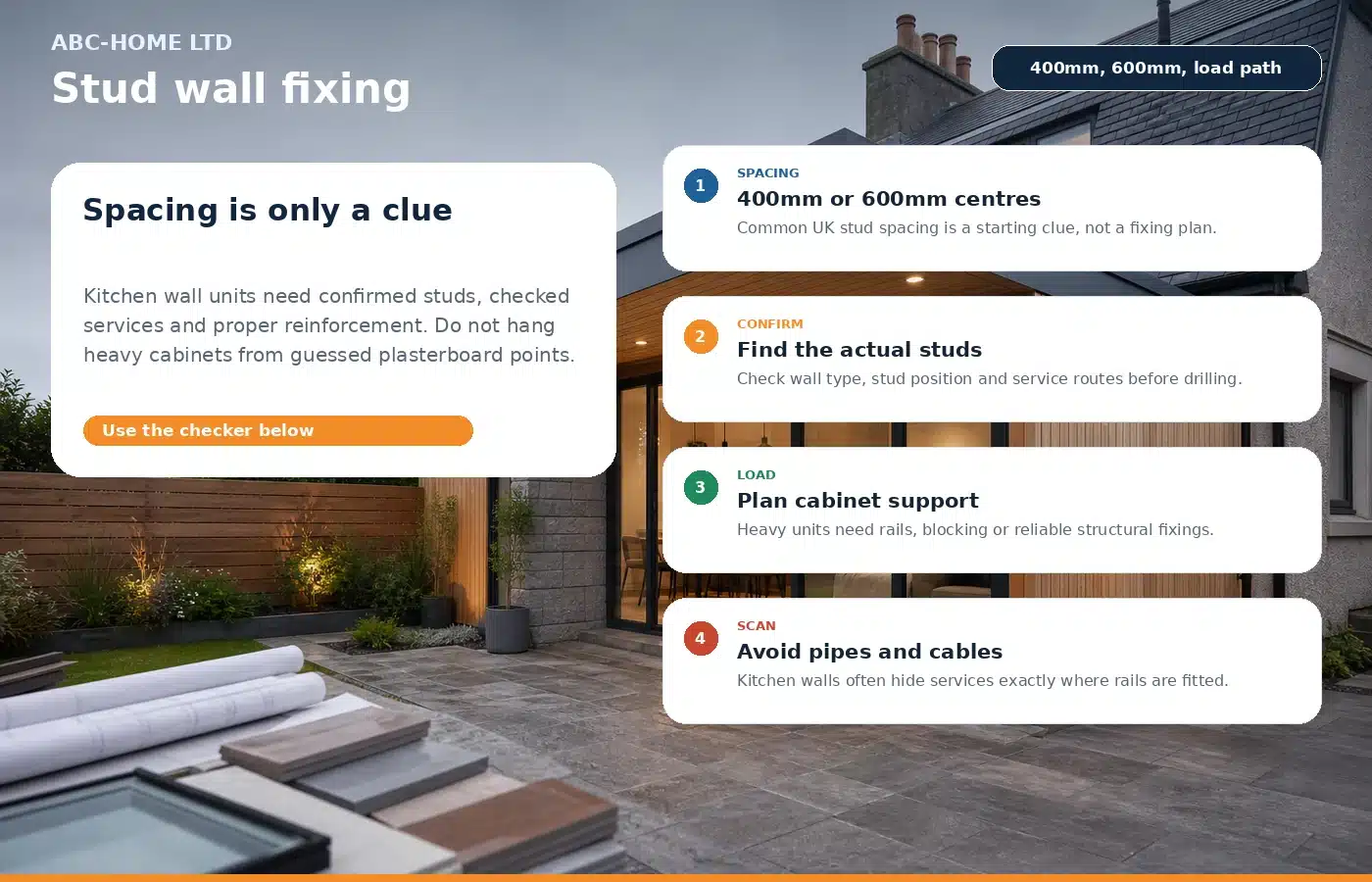
UK stud spacing and cabinet fixing table
| Wall clue | What it may mean | Kitchen fitting risk |
|---|---|---|
| 400mm centres | A common stud spacing used in many partitions and board layouts. | Still confirm every fixing point. Do not assume the wall stayed regular around doors, corners or previous repairs. |
| 600mm centres | Also common in UK drylining systems and some partition layouts. | Wider spacing can make cabinet rail planning more important because the rail may not land where you expect. |
| Metal studs | Often found in newer partitions or certain drylining systems. | Need compatible fixings and load judgement. Timber-stud assumptions can fail. |
| Dot-and-dab board | Plasterboard bonded to a masonry wall with voids behind. | The fixing may need to reach the masonry, bridge the void properly, and avoid crushing board. |
| Solid masonry | Brick, block or stone behind the finish. | Usually a stronger route, but substrate condition, fixing type and hidden services still matter. |
Kitchen wall unit fixing risk checker
Use this before cabinet rails, brackets or heavy shelves are drilled into a kitchen wall.
Solid masonry or confirmed strong substrateTimber stud partitionMetal stud partitionDot-and-dab plasterboard over masonryUnknown wall type
Shelf or light railSmall kitchen wall unitFull run of kitchen wall unitsBoiler, heavy appliance or heavy cabinet
Yes, structure confirmed at fixing pointsOnly checked with a stud finderNo, using expected spacing only
Open wall or bare boardPainted plasterboardTiled wall or splashback fitted
Cable and pipe routes checkedServices not checked yet
Before boards, tiles or splashbackBefore cabinets onlyFinished kitchen
Choose the wall and cabinet conditions to get a fixing note.
Why average stud spacing is not enough
A quick answer of 400mm or 600mm centres is not enough for a kitchen. Wall units are not static picture frames. They hold crockery, hinges are pulled daily, doors slam, rails carry repeated load, and the wall behind may have been cut for sockets, extractor routes or plumbing.
Openings, corners, older alterations and patch repairs can break the expected spacing pattern. Measure, then confirm.
Standard plasterboard, moisture-resistant board, tile backer, insulated board and double board all behave differently.
Kitchens hide cable drops, pipe runs, extractor feeds and old service chases exactly around the wall-unit zone.
A fixing mistake behind a splashback is slower to inspect, patch and make good than one made before finishes go on.
Better sequence before fitting wall units
- Identify the wall type before choosing fixings.
- Mark the proposed cabinet rail or bracket line on the actual wall, not only on the plan.
- Find studs or masonry at the real fixing points and check the line for cables and pipes.
- If the wall is open, add blocking, pattress or reinforcement before boards and tiles hide the structure.
- Use fixings that match the wall construction and the cabinet load, not the cheapest plug in the van.
- Photograph routes and reinforcement before the kitchen is closed up.
When to add reinforcement
If full wall units are going onto a stud partition, the cleanest answer is often to plan reinforcement before the finish. A continuous fixing rail, timber blocking or pattress can spread the load and give the fitter predictable fixing points. That is much better than hunting for one stud after the splashback is already fitted.
This is especially useful where cabinets meet extractor units, tall cupboards, corner units or heavy storage. It also helps if the household may change the wall layout later, because the structure is already known and documented.
If wall units, wiring and splashbacks all need coordinating, ABC Home can include structure, services and cabinet fixing checks within a kitchen fitting project in Aberdeen.
Sources and practical checks
- Knauf drywall partitions: drylining and partition context where stud centres and board systems affect fixing decisions.
- TradeFox UK stud spacing explainer: common 400mm and 600mm stud spacing background.
- Electrical Safety First DIY and electrics: warning about drilling, nailing or screwing where hidden cables may be present.
- ABC Home kitchen wire run guide: further reading on kitchen service-route planning before cabinets and splashbacks are fitted.
Wall board and cabinet fixing references
Stud spacing is only part of the fixing decision. Heavy kitchen wall units need a suitable structure, and the plasterboard system should be checked before relying on fixings alone. Knauf and Gyproc give useful wall-board context, while Building Standards thinking matters where wall alterations, services or fire/safety details are being changed.
- Knauf gypsum and plasterboard systems: wall-board product and system background.
- Gyproc / British Gypsum: plasterboard and drylining system reference.
- Scottish Government Building Standards: reference route where wall structure, services or safety assumptions change.
FAQ
How far apart are wall studs in the UK?
Many UK stud partitions are set around 400mm or 600mm centres, but you must confirm the actual wall before drilling. Alterations, old repairs, metal studs, dot-and-dab boards and service routes can all break the pattern.
Can kitchen wall cabinets be fixed to plasterboard?
Light items may use specialist plasterboard fixings, but full kitchen wall units should be fixed into a suitable structure, rail, blocking or masonry substrate. Do not rely on ordinary plasterboard alone for heavy cabinets.
Should I add noggins or pattress before fitting kitchen wall units?
If the wall is open or being reboarded, adding timber blocking, pattress or a continuous fixing rail is usually cleaner than trying to rescue weak fixing points after tiling.
Can a stud finder locate pipes and cables?
Some detectors help, but they are not perfect. Kitchens often contain cables, pipes, foil-backed boards and metal accessories that can confuse readings, so use service checks and cautious pilot investigation.